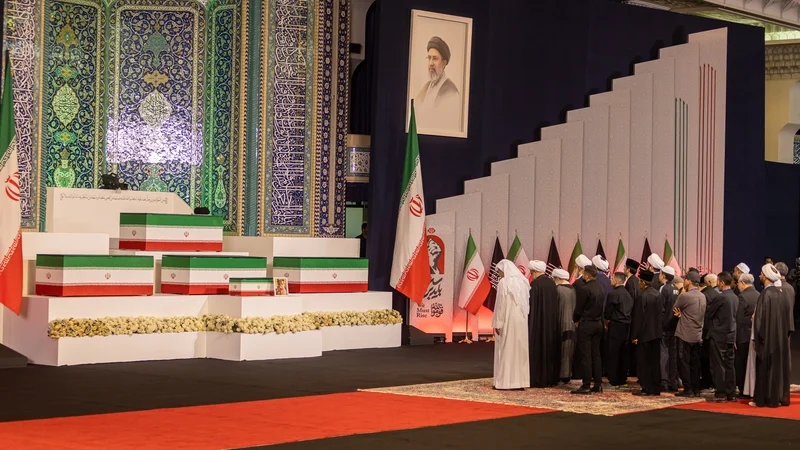
The body of Iran’s late Supreme Leader, Ali Khamenei, has been placed in state at Tehran’s Grand Mosalla ahead of a state funeral expected to draw millions of mourners and dozens of foreign dignitaries.
Khamenei was killed during U.S.-Israeli strikes that escalated into the recent Middle East conflict. His coffin, draped in Iran’s national flag, was carried into the Grand Mosalla, one of the country’s most significant religious and ceremonial venues, where it will remain for three days before burial.
Thousands of mourners, many dressed in black, gathered for a pre-funeral ceremony as the coffin was placed before a backdrop of flowers and memorial decorations. Among those paying their respects was Ahmad Vahidi, head of Iran’s Revolutionary Guards, making his first public appearance since the outbreak of the conflict.
The funeral arrangements come as Iran and the United States observe a fragile ceasefire following a preliminary agreement aimed at ending hostilities.
Several countries have confirmed they will send official delegations to the funeral. Pakistan’s Prime Minister Shehbaz Sharif is expected to attend, while China, Afghanistan and several neighbouring Caucasus nations have also announced plans to be represented.
Workers have been preparing the Grand Mosalla for the ceremony, decorating the venue with flowers and banners bearing Khamenei’s image and quotations. Security has been tightened across the capital, with roads closed and vehicle movements heavily restricted around the funeral site.
Iranian Parliament Speaker and chief negotiator Mohammad Bagher Ghalibaf called on citizens to attend in large numbers, describing the funeral as a defining moment in the nation’s history. He urged Iranians to demonstrate unity and honour the late leader through their participation.
Khamenei, who led Iran for decades and remained one of the most influential figures in the Islamic Republic, died at the age of 86. The bodies of several relatives who were also killed in the strikes will lie in state alongside him.
Iranian officials estimate that between 15 and 20 million people could attend the funeral, potentially making it the largest state funeral in the country’s history.
Public holidays have been declared in Tehran and the holy cities of Qom and Mashhad to allow citizens to participate in the ceremonies. Government offices and many businesses in the capital will remain closed through Monday, while significant traffic restrictions and partial airspace closures have been imposed.
After the ceremonies in Tehran, Khamenei’s body is scheduled to be taken to the Iraqi holy cities of Najaf and Karbala before being buried on July 9 at the shrine of Imam Reza in Mashhad, his birthplace.
Representatives from around 30 countries are expected to attend the funeral as mourners continue arriving in Iran from neighbouring Iraq, Afghanistan and Pakistan.