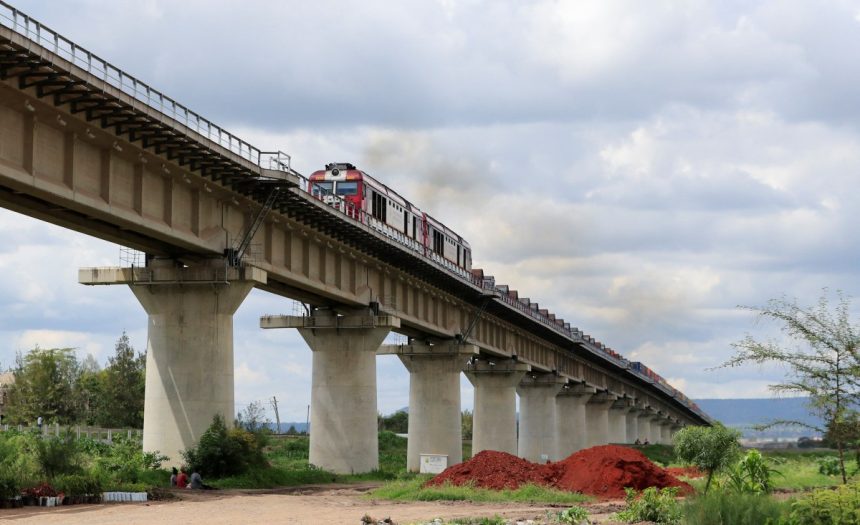
The presidents of Kenya and Uganda were set to meet near their shared border on Saturday to mark the multi-billion-dollar, long-delayed extension of a Chinese-built railway that has left Kenya heavily in debt.
The Standard Gauge Railway, built from 2013 to 2019, connects the Kenyan port city of Mombasa to its capital Nairobi and on to the lake town of Naivasha, but China refused further lending before it could be extended to Uganda as originally planned.
Kenya now spends roughly $1 billion a year servicing Chinese debt, most of it borrowed to build the railway. That figure is far higher than the revenue generated by the line — around $165 million last year — even though passenger and cargo numbers have grown significantly over the past year.
A report by Kenya’s auditor general last year also found that more than $260 million had been lost to penalties and interest from late debt repayments.
Despite the controversy surrounding the cost, Kenya has remained determined to complete the project. President William Ruto broke ground on the next phase in Narok County on Thursday, saying the railway will catalyse regional economic growth, position Kenya as a major transport and logistics hub in eastern and central Africa, create jobs, and reduce road congestion.
“We have thought through this project and its finance,” he said.
Ruto is expected to meet his Ugandan counterpart Yoweri Museveni in Kisumu near the Kenya-Uganda border, where the line is projected to reach by June 2027 if construction proceeds on schedule. The next phase will then extend the railway to Malaba, a border town.
Treasury estimates suggest the overall cost of the extension will exceed 500 billion shillings ($3.9 billion), according to Business Daily.
This time, Kenya is not taking additional loans from Chinese banks. Instead, it plans to borrow against future cargo taxes while partnering with Chinese transport firms to build the new phase.
Between 2000 and 2019, China lent Kenya $9.7 billion, according to the Chinese Loans to Africa Database by Boston University, with about half of the funding going to the railway project. Lending paused between 2020 and 2023 as Kenya struggled with repayments, during a period when China also revised its wider lending strategy to Africa.
Kenya views the railway extension as crucial for boosting trade across east and central Africa, with plans to connect landlocked countries including Rwanda, South Sudan and the mineral-rich Democratic Republic of the Congo.
AFP.