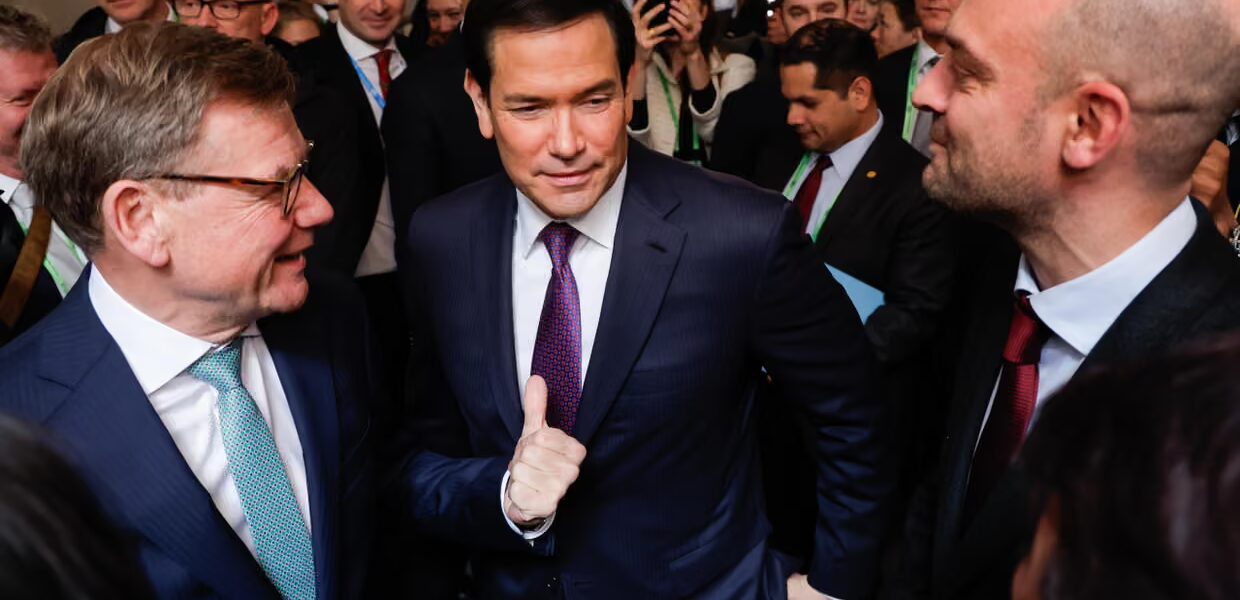
U.S. Secretary of State Marco Rubio has told European leaders that Washington is seeking to renew its alliance with Europe — but on terms consistent with Donald Trump’s vision for a reshaped global order.
Addressing policymakers at the Munich Security Conference, Rubio described the United States as “a child of Europe,” stressing that both sides “belong together.” He said the U.S. would prefer to construct a new world order in partnership with Europe rather than act independently.
While we are prepared, if necessary, to do this alone, it is our preference and it is our hope to do this together with you, our friends here in Europe,” Rubio said. He acknowledged that Americans may sometimes sound blunt or urgent but attributed that tone to deep concern about Europe’s future and the shared destiny of both continents.
Observers noted that while Rubio’s speech struck a more conciliatory tone than some previous remarks from senior U.S. officials, it stopped short of proposing a partnership of equals. Instead, it underscored Washington’s expectation that Europe align with Trump’s strategic priorities.
Rubio said the U.S. does not want a Europe weakened by what he called “guilt or shame.” “We in America have no interest in being polite and orderly caretakers of the west’s managed decline,” he said, adding that the goal was not separation but revitalisation of a longstanding transatlantic bond.
He argued that both sides of the Atlantic had made shared policy errors, including overdependence on globalisation, expanding welfare commitments at the expense of defence spending, and what he described as excessive climate-driven policies. On immigration, Rubio maintained that securing borders was not rooted in hostility but was “a fundamental act of national sovereignty,” warning that inaction could undermine social cohesion.
Regarding global institutions, Rubio called for reform rather than dismantlement, suggesting that under Trump, the U.S. had acted more decisively in crises such as Gaza and Ukraine than multilateral organisations.
“In a perfect world, all of these problems and more would be solved by diplomats and strongly worded resolutions,” he said. “But we do not live in a perfect world.”
Though Ukraine was not a central focus of his remarks, Rubio said diplomatic engagement had narrowed differences among stakeholders, even if the most complex issues remained unresolved.
He concluded by urging European allies to join Washington’s approach to global leadership. “This is the path that President Trump and the United States has embarked upon,” Rubio said. “It is the path we ask you here in Europe to join us on.”