
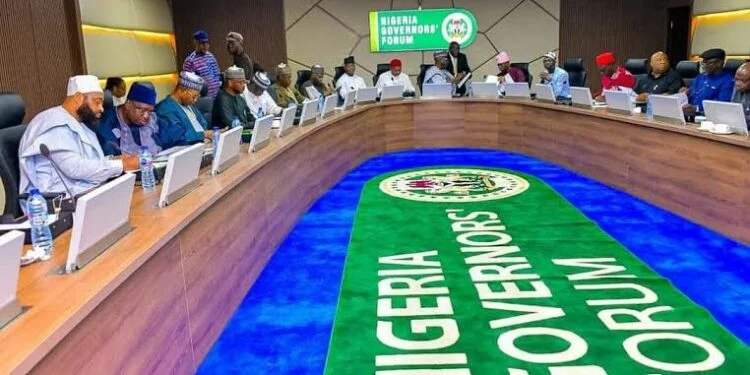
Despite receiving an estimated N9 trillion from the Federation Account Allocation Committee (FAAC) in 2025, state governments are facing growing criticism from labour unions, civil society groups, and opposition parties over what many describe as a widening gap between soaring revenues and tangible improvements in citizens’ lives.
FAAC allocations to states rose by over N2 trillion compared to 2024, according to National Bureau of Statistics data collated by The PUNCH. The surge highlights a significant revenue windfall for subnational governments amid higher federation inflows.
Critics argue that increased allocations have failed to improve welfare due to weak governance, corruption, and misplaced priorities. The Nigeria Labour Congress (NLC) warned that many states have not translated federal funds into visible development outcomes. Civil society organisations echoed these concerns, calling for greater accountability and oversight.
Economists note that while higher allocations expand states’ fiscal space, heavy reliance on federally shared revenue and poor revenue management continue to hinder sustainable development.
FAAC breakdown
States received N7.315 trillion from FAAC in 2025, up from N5.186 trillion in 2024—a 41% increase. Including the constitutionally mandated 13% derivation revenue, total inflows climbed to N8.934 trillion, up from N6.533 trillion in 2024.
Monthly allocations improved steadily, peaking at N727.17 billion in October 2025, compared with a maximum of N549.79 billion in 2024. Derivation payments to oil-producing states also rose to N1.619 trillion, up from N1.347 trillion the previous year.
Despite these gains, the relative share of states’ allocations in total FAAC distributions declined slightly, reflecting rising federal and local government allocations.
Heavy reliance on federal allocations
The BudgIT State of States Report 2025 revealed that over 30 states depend on FAAC for more than 60% of recurrent revenue, with 31 states relying on it for over 80%. Analysts warn that such dependence discourages the development of internally generated revenue (IGR) and exposes states to volatility from oil price shocks.
Dr. Aliyu Ilias of CSA Advisory recommended a counterpart funding system, where states increasing IGR would receive proportional benefits, cautioning that without incentives, FAAC inflows may continue to fail in improving living standards.
Labour and civil society criticism
The NLC said rising allocations have not delivered benefits due to mismanagement and corruption. Assistant Secretary-General Onyeka Christopher said, “The idea behind federal allocations is to bring government closer to the grassroots, but in many states, this has not translated into the desired results.”
CSOs echoed the concerns. Debo Adeniran of the Centre for Accountability and Open Leadership described states as “meddlesome interlopers” mismanaging funds, while CISLAC’s Auwal Musa Rafsanjani said there is no verifiable evidence that allocations are improving healthcare, electricity, infrastructure, or agriculture.
Opposition parties weigh in
Opposition figures across states criticized governors for failing to translate allocations into development:
-
In Lagos, George Ashiru of the ADC said rising funds had not eased hardship, as inflation and neglect of inner-city areas persist.
-
In Sokoto, PDP spokesman Hassan Sahabi Sanyinnawal said most LGs received no benefits despite huge allocations.
-
In Plateau, Bauchi, Zamfara, and Kebbi, opposition parties cited poor schools, healthcare, and lack of basic services, accusing governments of prioritizing luxury projects and propaganda over citizen welfare.
Contrasting views
Some ruling parties and states defended their record:
-
In Nasarawa, the Labour Party praised Governor Abdullahi Sule for infrastructure projects like the N16bn Lafia flyover and ongoing road works.
-
In Kwara, the APC highlighted investments in infrastructure, education, healthcare, and social programs across all senatorial districts, countering PDP claims of neglect.
Analysts’ takeaway
Experts emphasize that while FAAC inflows are unprecedented, poor fiscal management, corruption, and overreliance on federal transfers prevent increased funds from improving citizens’ living standards. They call for greater transparency, accountability, and incentives for internally generated revenue to ensure the benefits of Nigeria’s wealth reach the grassroots.
