
New York and 21 other U.S. states have filed a lawsuit against the Trump administration, seeking to block a new Department of Homeland Security (DHS) rule that would give immigration officials broader discretion to deny green cards, visas or entry to applicants deemed likely to become dependent on government assistance.
The proposed rule expands the categories of public benefits that immigration officials can consider when determining whether an applicant is likely to become a “public charge.”
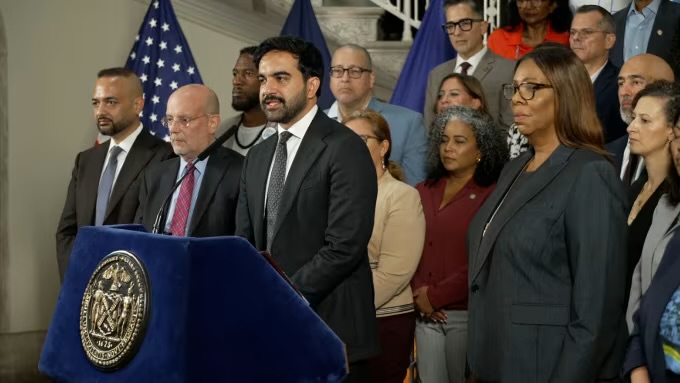
New York Attorney General Letitia James and New York City Mayor Zohran Mamdani, who is leading a coalition of local governments in a parallel lawsuit, announced the legal challenge during a news conference at Manhattan City Hall.
James said the rule would allow immigration officials to consider the use of essential benefits, including Medicaid, the Supplemental Nutrition Assistance Program (SNAP) and school meal programmes, when assessing an applicant’s circumstances.
“The rule would allow immigration officers to consider use of critical benefits like Medicaid and SNAP, and even participation in school meal programs, as part of an applicant’s circumstance,” James said.
“That means immigrant New Yorkers may be forced to ask themselves impossible questions: ‘Will getting health insurance hurt my chances of getting a green card? Will accepting food assistance when I fall on hard times be held against me?’”
The legal challenge centres on revisions to the longstanding “public charge” provision of U.S. immigration law, which allows the government to deny certain visa or green card applications to individuals deemed likely to rely primarily on government assistance.
Historically, immigration officials focused largely on cash benefits such as Supplemental Security Income and Temporary Assistance for Needy Families. Under the proposed DHS framework, however, officials would be permitted to consider non-cash benefits, including housing assistance and Medicaid, when making eligibility determinations.
The rule primarily affects immigrants seeking to maintain or obtain legal status in the United States, as undocumented immigrants are generally ineligible for federal public benefits.
The policy shift follows federal legislative measures, including the “One Big Beautiful Bill Act,” enacted in July 2025, which restricted access to Medicaid and food assistance for certain legal immigrants while exempting refugees, asylees and victims of domestic abuse or sex trafficking.
Although U.S. citizen children remain eligible for the benefits, state officials said administrative changes and concerns about immigration enforcement can lead to eligible members of mixed-status households being disenrolled.
In its lawsuit, New York argues that DHS exceeded its statutory authority, contending that Congress did not authorise the agency to expand the definition of a public charge in the manner proposed.
The lawsuit also describes the rule as “arbitrary and capricious,” alleging that DHS failed to adequately justify the expansion or assess its potential economic impact on state healthcare and social welfare systems.
The states’ lawsuit and a parallel action filed by local governments, including Chicago, San Francisco, Seattle, Santa Clara County and King County, were filed in the U.S. District Court for the Southern District of New York.
The plaintiffs are asking the court to declare the policy unlawful and prevent DHS from implementing it.
James sharply criticised the proposed rule, accusing the Trump administration of deliberately creating fear among immigrant communities.
“Cruelty is the point. Having a chilling effect on immigrants is the point. Letting individuals know that they are not welcome here is the point. Immigration animus is the point,” she said.
“To see the federal government pursue rule changes and legislation that will make hungry New Yorkers hungrier, that will make poor New Yorkers poorer, it is a slap in the face to everything that we should be doing in this moment, which is to make it easier for working-class New Yorkers to afford their life here in the city.”
