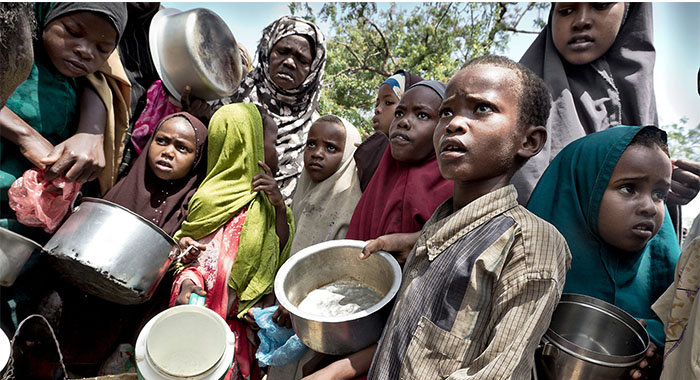
A new UN-backed report has revealed that Nigeria and nine other countries now account for two-thirds of the world’s population facing acute food insecurity.
The 2026 Global Report on Food Crises, released Friday by a coalition of UN agencies, the European Union and humanitarian partners, found that 266 million people across 47 countries experienced high levels of acute food insecurity in 2025. This represents nearly a quarter of the population assessed and almost double the proportion recorded in 2016.
“Acute food insecurity today is not just widespread — it is also persistent and recurring,” said Qu Dongyu, Director-General of the Food and Agriculture Organization, warning that the crisis has become structural rather than temporary.
In Nigeria alone, the UN Office for the Coordination of Humanitarian Affairs had earlier estimated in January that 35 million people are at risk of acute hunger in 2026.
The report identified conflict as the primary driver of food insecurity, alongside worsening climate shocks, noting that conditions are likely to persist or deteriorate in many countries.
It highlighted a severe concentration of the crisis in 10 countries: Afghanistan, Bangladesh, the Democratic Republic of the Congo, Myanmar, Nigeria, Pakistan, South Sudan, Sudan, Syria, and Yemen.
While some improvements were recorded in countries such as Bangladesh and Syria, these were largely offset by worsening conditions in Afghanistan, the DRC, Myanmar and Zimbabwe.
For the first time in its 10-year history, the report confirmed famine conditions in two locations within the same year — Gaza and parts of Sudan.
It also warned that declining international aid and escalating geopolitical tensions, particularly in the Middle East, could further worsen global food insecurity by increasing displacement and pushing up food production costs.
The ongoing disruption of the Strait of Hormuz has also driven up fertiliser prices due to its reliance on oil-based inputs.
“Now we’re in planting season,” said Álvaro Lario, head of the UN’s International Fund for Agricultural Development (IFAD). “This current food shock — with rising energy and fertiliser costs — will have a massive impact on production.”
Lario called for greater investment in small-scale farmers, including climate-resilient and water-efficient agriculture, as well as local fertiliser production and improved soil management to reduce dependence on costly inputs.