The Nigerian Midstream and Downstream Petroleum Regulatory Authority (NMDPRA) has released its ‘State of the Midstream and Downstream Fact Sheet’ for November 2025, showing sustained improvement across fuel supply, stock levels, and domestic production capacity.
According to the Authority, the month under review reflected a more stable petroleum products market, with key indicators pointing to better sufficiency, increased refining activity, and stronger gas supply to households, industries, and export obligations.
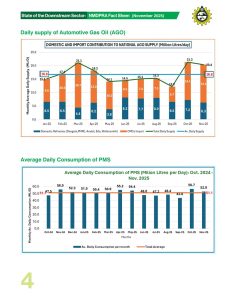
The report shows that the country recorded an average “71.5 million litres per day of Premium Motor Spirit (PMS)” in national supply, pushing national sufficiency to “16.65 days”, a notable improvement compared to earlier months. Actual daily PMS consumption stood at “52.9 million litres”, indicating a healthier supply buffer across the value chain.
In the Automotive Gas Oil (AGO) segment, the market maintained stability with “20.4 million litres per day” supplied and “15.4 million litres per day” consumed nationwide. The Authority noted that diesel availability has remained consistent due to improved import scheduling and contributions from domestic refineries.
The report also highlights stronger performance in Liquefied Petroleum Gas (LPG), where an average of “4,958 metric tonnes per day” was supplied, a figure that exceeds national demand. The NMDPRA said this surplus is driving increased market confidence, improved penetration, and more reliable pricing.
On refining development, the Authority disclosed the issuance of “one refinery establishment licence” and “one construction licence” during the month. It further confirmed progress at “Waltersmith’s 5,000 barrels-per-stream-day Train 2”, which continued commissioning activities in November, adding to Nigeria’s push toward expanded domestic refining capacity.
Gas supply also recorded a positive trend, with “4.684 billion standard cubic feet per day” delivered for power generation, industrial use, and export commitments. The Authority said this volume underscores the sector’s growing role in stabilising electricity supply and supporting industrial productivity.
Overall, the NMDPRA stated that the November data reflects “clear progress” in efforts to stabilise fuel supply, strengthen local refining, and advance long-term national energy objectives.
The Authority added that Nigeria is “taking deliberate steps to secure a more resilient energy future,” urging stakeholders to maintain confidence in the ongoing reforms shaping the midstream and downstream sectors