
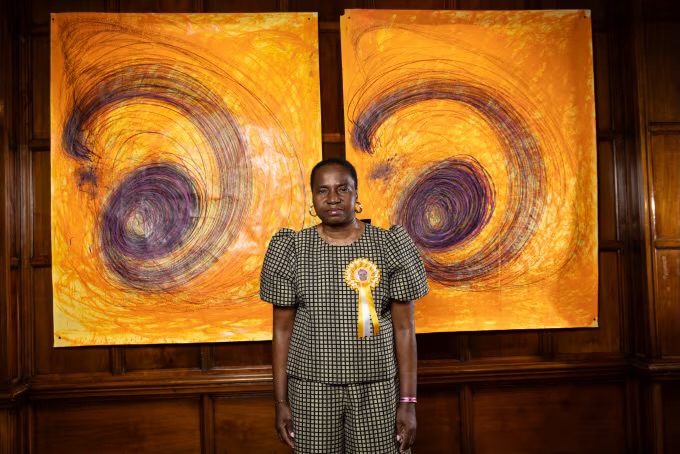
British-Nigerian artist Nnena Kalu has made history after becoming the first autistic person — and the first artist with a learning disability — to win the prestigious Turner Prize. The award, previously claimed by celebrated figures such as Damien Hirst and Steve McQueen, was presented during a ceremony in Bradford, UK.
Kalu, 59, who was born in Glasgow and has autism with limited verbal communication, was recognised for her striking large-scale draped sculptures and her unique vortex-like circular drawings. Her powerful works have earned growing admiration in recent years after decades of being overlooked.
She was joined on stage by representatives from ActionSpace, the inclusive arts charity where she has been a resident artist for more than 25 years. Speaking on her behalf, Charlotte Hollinshead, the organisation’s head of artist development, celebrated the groundbreaking moment.
“This amazing lady has worked so hard for such a long time — it’s wonderful she’s finally getting the recognition she rightly deserves,” Hollinshead said. She recalled how, when Kalu began at ActionSpace in 1999, her art was dismissed, unseen, and far from being considered ‘cool.’ She added that the Turner Prize win would “smash that prejudice away.”
Kalu began her artistic journey creating two-dimensional works before shifting to the sculptural practice that now defines her. Her signature sculptures often begin with a cocoon-like bundle of fabric and paper tightly wrapped in cellophane and tape. From there, she builds outward in rhythmic, repetitive movements, binding materials such as rope, coloured textiles, and even VHS tape, creating dense, immersive forms.
Around 2013, she expanded her practice to include her now-distinctive circular drawings — layered whirlpools of ink, graphite, acrylic pen, or oil pastel, often displayed in pairs or triptychs.
This year’s Turner Prize recognised the body of work she exhibited at Manifesta, the prominent cultural biennale held in Barcelona. Her pieces, including Drawing 21 and the series Hanging Sculpture 1–10, were praised by jurors for their boldness, expressive energy, and mastery of scale, composition, and colour.
Although she has been an artist for decades, Kalu’s commercial breakthrough only came last year after exhibiting with Arcadia Missa, the London gallery that now represents her. The gallery described her win as a “moment of recognition” that will shape cultural conversations for years to come.
Curator Lisa Slominski, author of Nonconformers: A New History of Self-Taught Artists, called Kalu’s nomination a “watershed moment,” noting the importance of seeing a learning-disabled artist with limited verbal communication celebrated on such a major stage. She also emphasised that Kalu’s work should not be interpreted only through the lens of disability, but valued for its artistic power and innovation.
For her win, Kalu receives £25,000, while the other shortlisted artists — Mohammed Sami, Rene Matić, and Zadie Xa — will each receive £10,000.