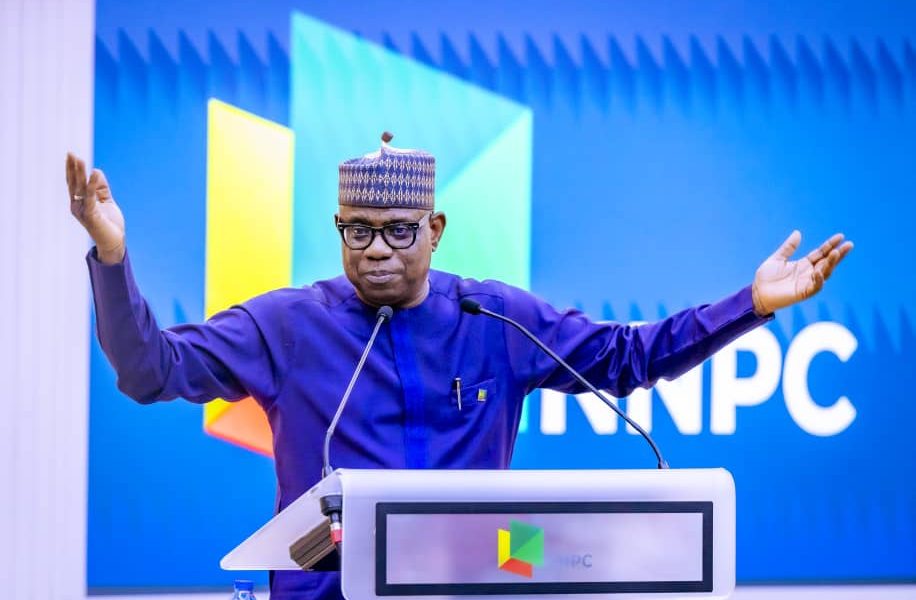
The Group Chief Executive Officer of NNPC Limited, Bayo Ojulari, has admitted that the national oil company currently lacks the capacity to operate refineries profitably, describing the reactivation of the Port Harcourt Refinery and Petrochemical Company as a major waste of resources.
Ojulari made the remarks on Wednesday, February 4, while speaking at the Nigerian International Energy Summit.
According to him, successful refinery operations require strong financing, competent Engineering, Procurement and Construction (EPC) contractors, and world-class operational and maintenance capacity — conditions he said NNPC does not presently possess.
The Port Harcourt Refinery, rehabilitated at a cost of about $1.5 billion under former NNPC Group Chief Executive Officer Mele Kyari, was reopened in November 2024 after nearly three years of rehabilitation. However, it was shut down again in May 2025 following sustained financial losses.
Ojulari said a detailed internal review revealed the facility was operating at a significant loss.
“The first thing that became clear was that we were running at a monumental loss to Nigeria. We were just wasting money. I can say that confidently now,” he said. “So the first decision I had to make was to stop the rot by shutting it down and then quickly recalibrating to see what could be done.”
He questioned how the refinery continued to post losses despite receiving regular crude oil supply.
“We were pumping cargo into the refinery every month, but utilisation was around 50 to 55 per cent. Those cargoes have value, and we were losing that value. We were spending a lot of money on operations and contractors, yet when you look at the net outcome, we were just leaking value with no clear path to profitability,” he added.
Ojulari disclosed that NNPC is now seeking partnerships with established refinery operators that have proven experience in running facilities profitably.
“To make a refinery work, you need three things: financing to support operations, a competent EPC contractor, and world-class operational capacity,” he said.
He explained that the company’s new strategy, approved by its board, is to partner with experienced refinery operators rather than engage contractors or maintenance service providers.
“We are not looking for contractors. We are not looking for O&M service providers. We are looking for an entity that actually runs refineries,” Ojulari said.
He added that the successful operation of the Dangote Refinery has reduced pressure on government to rush decisions about reviving state-owned refineries.
“There was a lot of pressure about continuity, but we were not under that pressure. And thank God for Dangote Refinery. Whether you love Dangote or hate him, thank God. He is a Nigerian, and that has given us breathing space because we now have a refinery that is working,” he said.
On crude oil production, Ojulari expressed optimism that Nigeria could reach 1.8 million barrels per day in 2026. However, he described the Federal Government’s 2025 budget benchmark of 2.06 million barrels per day as overly ambitious, noting that average production in the previous year was about 1.7 million barrels per day.
“One of the financial problems Nigeria faced last year was overprojection. We overprojected production and revenue, and by mid-year oil prices were lower while production was below projections, yet spending plans had already been made. That has far-reaching consequences,” he said.
Ojulari stressed that credible and realistic production planning is essential to avoid future fiscal challenges.