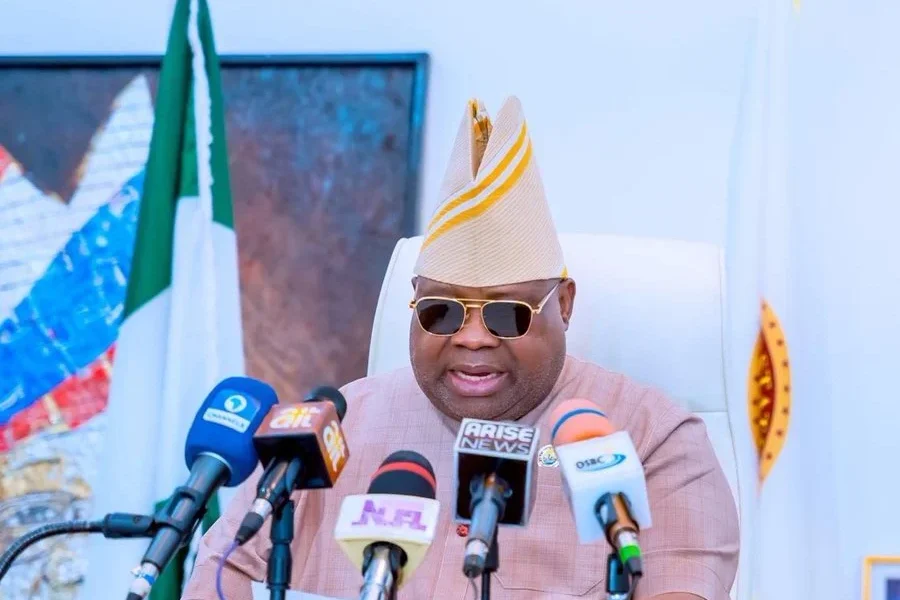
The National Youth Leader of the All Progressives Congress (APC), Dayo Israel, has described Governor Ademola Adeleke’s dancing and grassroots engagement as key political strengths that helped him connect with voters in Osun State.
Israel, in an article shared on Facebook on Sunday, said Adeleke’s ability to sing, dance and interact closely with ordinary people should not have been dismissed by his political opponents, who often focused on his public performances.
Adeleke of the Accord Party won Saturday’s Osun governorship election with 511,067 votes, defeating the APC candidate, Bola Oyebamiji, who polled 444,815 votes.
Reflecting on the election, Israel urged the APC to reassess its campaign strategies and approach to voter engagement ahead of the 2027 general elections.
He identified Adeleke as one of three personalities who, in his assessment, shaped the outcome of the election.
According to Israel, Adeleke’s willingness to embrace the culture and emotions of the people strengthened his appeal at the grassroots.
“Governor Adeleke’s dancing was never a weakness. It was a political language. It humanised him, made him accessible and created emotional proximity with ordinary voters,” he said.
Israel added that Adeleke’s singing, dancing, accessibility and public worship helped create an emotional bond with voters that some political analysts failed to recognise.
“Politics is not only policy. It is emotion, identity, presence and belonging,” he said.
The APC youth leader warned his party against equating elite approval with electoral strength, noting that candidates who appeal to political elites may still struggle to win support at the grassroots.
“Our party must therefore stop confusing sophistication with electoral value. A candidate may dominate elite discourse and still fail to move a ward. Another may be mocked in elite spaces and still command overwhelming loyalty on the ground,” Israel said.
He also credited Davido, the governor’s nephew and music star, with playing a significant role in mobilising young voters for Adeleke.
Israel said Davido leveraged his influence, networks, music, digital reach and personal credibility to connect the campaign with younger voters.
“Davido did not treat his role as symbolic. He was placed at the centre of youth mobilisation and used his influence, networks, music, digital reach and personal credibility to connect the campaign to a generation,” he said.
Questioning whether the APC has young personalities capable of exerting similar influence, Israel asked: “Who are the Davidos in the APC?”
He said the APC’s defeat in Osun should also compel the party to address internal divisions, weak grassroots structures and what he described as inadequate engagement with its youth and women wings.
Israel argued that campaign structures should be established well ahead of elections instead of being hurriedly assembled shortly before polling.
“A campaign council must be formed early, properly funded, given clear deliverables and held accountable. Anything less is theatre, not strategy,” he said.
He also called for reconciliation among party members ahead of the 2027 elections, stressing that broader inclusion would be essential to achieving electoral success.
Concluding his assessment, Israel said the APC should learn from Adeleke’s connection with voters and Davido’s influence among young people.
“President Tinubu gave us a democratic contest. Governor Adeleke understood his people. Davido understood his generation.
“The question is whether the APC understands its own lesson,” he added.