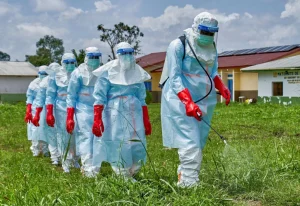
The Senate has called on the Federal Government to release emergency funds from the Service-Wide Vote to strengthen preventive measures against the Ebola threat and avert a possible outbreak in Nigeria.
The resolution followed the adoption of a motion sponsored by Senator Francis Ade Faduyile (APC, Ondo South), who called for mandatory health screening of passengers arriving through Nigeria’s international airports, seaports and designated land borders.
Faduyile said reports of an Ebola outbreak in the Democratic Republic of the Congo and its spread to other countries required urgent preventive action to safeguard Nigerians.
He urged the Federal Government to introduce compulsory health declaration forms, temperature checks and symptom screening for all international arrivals, regardless of nationality or country of departure.
The senator also advocated enhanced screening for travellers who had visited or transited affected areas within the preceding 21 days, as well as exit screening during declared public health emergencies.
He said Nigeria’s entry points should be equipped with trained port health officers, thermal scanners, protective equipment and isolation facilities. He further called for isolation and treatment centres across the 36 states and the Federal Capital Territory to be placed on alert.
Faduyile also urged the government to modernise the Quarantine Act of 1926 and provide adequate funding for the Nigeria Centre for Disease Control and Prevention (NCDC) and Port Health Services.
Seconding the motion, Senator Ekong Sampson (APC, Akwa Ibom South) described Ebola as a deadly disease, warning that a single case could trigger widespread transmission if not detected and contained promptly.
Sampson stressed the need for Nigeria to strengthen its healthcare response and act swiftly to protect citizens.
Contributing to the debate, Senator Adamu Aliero (APC, Kebbi Central) said the Federal Ministry of Health had initiated measures through the NCDC to address the threat.
However, Aliero warned that the country could not afford to wait for the 2027 budget or a supplementary appropriation before releasing funds for an emergency response.
He called on the Ministries of Finance and Budget and Economic Planning to make funds immediately available to the relevant agencies through the Service-Wide Vote.
According to him, delays in funding could weaken efforts to contain the disease, while the NCDC and Port Health Services needed urgent resources to improve surveillance and screening at the country’s entry points.
The Senate subsequently adopted the proposal, urging the Federal Government to release emergency funds through the relevant ministries to support measures aimed at preventing the introduction and spread of Ebola.
Senate President Godswill Akpabio expressed concern over reports that a traveller had entered Nigeria without adequate screening upon arrival, raising questions about the effectiveness of health checks at the country’s entry points.
Akpabio recalled Nigeria’s experience during the 2014 Ebola outbreak, warning that failure to identify an infected traveller early could expose a large number of people to the disease.
He called for comprehensive screening of all international arrivals, irrespective of their countries of departure, noting that infected persons could travel through third countries before arriving in Nigeria.
The Senate President also urged the Senate Committee on Judiciary to engage relevant health authorities without delay to review the Quarantine Act and strengthen the legal framework for responding to public health emergencies.
The Senate urged Nigerians and relevant authorities to remain vigilant and support efforts to prevent an Ebola outbreak in the country.