
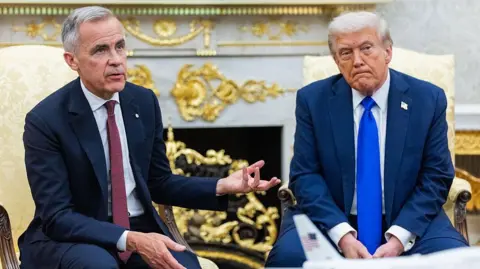
Six Republican lawmakers in the US House of Representatives broke ranks with Donald Trump to join Democrats in passing a measure aimed at repealing his tariffs on Canada, dealing a rare blow to a central part of the president’s second-term economic agenda.
The vote, which Republican leaders had worked aggressively to prevent, highlights growing unease within the party over Trump’s expanding trade policies. While the president continues to wield strong influence over the GOP, the defection signals emerging cracks as some lawmakers respond to pressure from constituents feeling the economic impact of the tariffs.
The six Republicans who supported the measure were Representatives Thomas Massie, Don Bacon, Kevin Kiley, Jeff Hurd, Brian Fitzpatrick and Dan Newhouse.
Trump quickly lashed out on his Truth Social platform, warning Republicans against opposing his tariff agenda.
“Any Republican, in the House or the Senate, that votes against TARIFFS will seriously suffer the consequences come Election time, and that includes Primaries!” he wrote.
House Speaker Mike Johnson attempted to play down tensions, telling reporters after visiting the White House that Trump was “not upset” and stressing that the president retains veto power.
“It’s not going to affect or change his policy. He can veto these things if they come to it,” Johnson said, later describing the vote as a “fruitless exercise” since there is no two-thirds majority in either chamber to override a veto.
Democrats were able to force a vote using a procedural mechanism that allows tariff-related resolutions to advance with a simple majority. Similar efforts targeting Trump’s tariffs on Mexico and his broader “liberation day” tariffs are expected in the coming weeks.
The Senate has already passed a comparable measure to roll back the Canada tariffs, though any final bill would almost certainly be vetoed by the president.
Several Republicans who crossed party lines cited economic harm in their districts. Hurd told CNN that farmers and steel manufacturers back home are already feeling the strain.
“At the end of the day, I looked at the Constitution, I looked at what was in the best interest of my district, and I took the vote,” Hurd said. “It’s not easy, but it’s the right thing and I stand by it.”
Newhouse, who is retiring at the end of his term, pointed to Washington state’s close trade ties with Canada and rising costs for fertilizer, equipment and other agricultural inputs.
Bacon, also retiring, framed his decision as both an economic and constitutional issue, arguing that Congress — not the White House — should have primary authority over tariffs. He added that many Republicans privately share his concerns but are hesitant to challenge Trump publicly.
Earlier estimates suggested as many as 30 Republicans could support the measure, but intense pressure from party leaders and the White House ultimately limited defections to six.