State governments are heading into 2026 with expansive spending plans, but weak internally generated revenue (IGR) is forcing many to depend heavily on federal allocations, borrowing and other temporary inflows to fund their budgets, Sunday PUNCH reports.
An analysis of appropriation bills and approved estimates across several states shows that only a few can finance a substantial share of their expenditure from IGR, raising questions about the sustainability of ambitious capital programmes.
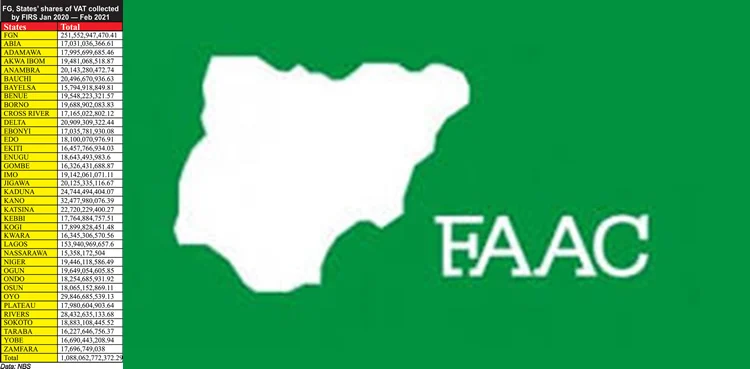
The review indicates that most governors remain fiscally dependent on Abuja. Federally shared revenue from the Federation Accounts Allocation Committee (FAAC) continues to be the largest and most reliable funding source for states, complemented by value-added tax (VAT) proceeds and, for oil-producing states, derivation revenue.
Lagos State, the country’s commercial hub, plans to spend N4.237tn in 2026—the largest subnational budget to date. Governor Babajide Sanwo-Olu said the budget, anchored on the T.H.E.M.E.S.+ agenda, would be financed mainly through N3.12tn in IGR and federal transfers, with the balance sourced from bonds and loans. Despite its strong tax base, Lagos still requires borrowing to close its funding gap.
Abia State presents a more constrained picture. Governor Alex Otti proposed a N1.016tn budget, with N811.8bn (80 per cent) allocated to capital projects and N204.4bn (20 per cent) to recurrent spending. Expected revenue totals N607.2bn, comprising N83.2bn from FAAC, N67.1bn from VAT, N26.5bn from grants and aid, and N168bn from other federal sources.
This leaves a funding gap of N409bn—about 40 per cent of the budget. While recurrent expenditure is expected to be fully covered by IGR, capital projects will rely largely on federal inflows, grants and borrowing.
The Managing Director of Optimus by Afrinvest, Dr Ayodeji Ebo, warned that overreliance on federal transfers and borrowing poses risks to fiscal sustainability.
“These revenues are volatile and largely outside the control of states, leaving budgets exposed to oil price shocks. Over time, this dependence discourages innovation and the development of durable local revenue sources,” he said.
Ogun State’s N1.669tn “Budget of Sustainable Legacy” follows a similar pattern. The state projects N509.88bn from IGR, N554.81bn from federal transfers and N518.9bn from capital receipts, including loans and grants. Although the budget appears balanced on paper, more than 30 per cent of funding comes from non-recurring sources.
Enugu State proposed a N1.62tn budget, representing a 66.5 per cent increase over 2025. Capital expenditure accounts for N1.296tn (80 per cent), while recurrent spending stands at N321.3bn (20 per cent). Projected revenue includes N870bn from IGR, N387bn from federal allocations and N329bn from capital receipts. Analysts note that roughly one-fifth of planned spending depends on non-recurring funds.
Osun State approved a N723.45bn budget, with projected inflows of N421.25bn from recurrent revenue, N286.01bn from capital receipts and N16.19bn as an opening balance. While inflows match expenditure on paper, the heavy reliance on capital receipts raises execution risks.
Oil-producing Delta State plans to spend N1.664tn, allocating N1.165tn (70 per cent) to capital projects. Revenue projections include N720bn from statutory allocations and derivation revenue and N250bn from IGR, which the state expects to rise following reforms and fuel-subsidy removal. Despite this, Delta remains heavily dependent on oil-linked federal inflows.
Sokoto State’s N758.7bn “Budget of Socio-Economic Expansion” relies on N389.3bn from FAAC, N74.5bn from IGR and N233.8bn from grants and development funds. With IGR accounting for less than 10 per cent of projected revenue, the state remains highly dependent on federal and donor funding.
Fiscal expert Aliyu Ilias said states’ dependence on FAAC allocations poses long-term challenges for the federation. He proposed a counterpart funding model in which states that improve IGR receive proportional incentives from the Federal Government.
Ilias warned that despite record FAAC inflows, improved living standards have not followed. He urged greater focus on direct local government projects to ensure funds reach citizens more effectively.
Edo State’s N939.85bn budget combines N160bn from IGR, N480bn from FAAC, N153bn from grants and capital receipts and N146bn from public-private partnerships. While diversified, the budget remains vulnerable to delays in external funding.
Bayelsa State plans to spend N1.01tn, with projected revenue including statutory allocations, VAT, derivation proceeds, other FAAC inflows, N85.9bn from IGR, grants and domestic loans. Less than 10 per cent of projected revenue comes from IGR, underscoring the state’s reliance on oil-linked revenue.
Gombe State’s N535.7bn “Budget of Consolidation” allocates 69.3 per cent to capital expenditure. However, the budget depends heavily on non-recurring capital receipts and carryover balances to fund major projects.
Kwara State’s N644.004bn “Consolidation and Sustained Growth” budget is based on macroeconomic assumptions, including oil prices, exchange rates and GDP growth, making its execution highly sensitive to national economic conditions.
Experts insist that states must look inward and develop areas of comparative advantage, including agriculture, manufacturing, tourism, logistics and services. Ebo said attracting investment requires reliable infrastructure, predictable tax policies, streamlined regulation and stronger public-private partnerships.
“Fiscal sustainability will not come from higher transfers or more debt, but from productive local economies, broader tax bases, disciplined spending and smarter collaboration,” he said.
Analysts note that only a few states, including Ogun and Osun, have budgets closely aligned with projected revenue—and even these rely heavily on loans and capital receipts. Most states continue to stretch spending beyond guaranteed IGR, banking on federal inflows and borrowing.
Ilias added that while total projected revenue could reach N35tn, shortfalls would likely affect capital spending, as recurrent obligations must be prioritised. He stressed the need for fiscal discipline and strict adherence to the January-to-December budget cycle.
34 governors have presented their 2026 budget proposals to their respective Houses of Assembly, while Borno and Rivers states are yet to submit theirs for legislative approval.