
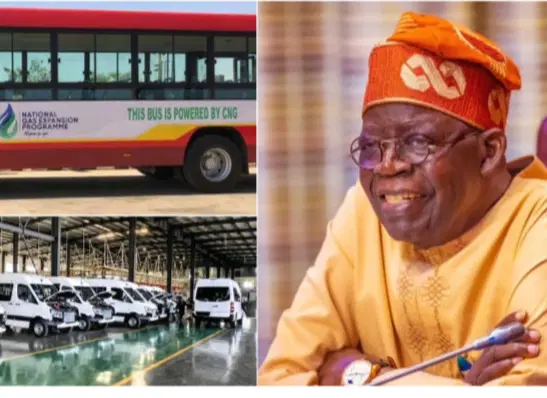
President Bola Tinubu has ordered the immediate nationwide deployment of about 100,000 compressed natural gas (CNG) conversion kits to help cushion the impact of rising fuel prices on Nigerians amid escalating tensions in the Middle East.
The Executive Chairman of the Presidential Initiative on Compressed Natural Gas (Pi-CNG), Ismaeel Ahmed, disclosed this after meeting with the President at the State House in Abuja on Tuesday, March 10.
Ahmed said the directive forms part of the Federal Government’s broader strategy to reduce transportation costs and expand the use of alternative energy, as global oil markets face volatility due to the ongoing United States–Israel conflict with Iran.
According to him, President Tinubu sought updates on the government’s response to the rising cost of petrol and diesel linked to the Middle East crisis.
“The President, as usual, wants to stay informed about what is happening, particularly with the war in the Middle East and the rising cost of petrol and diesel,” Ahmed said. “He asked what we are doing at Pi-CNG and in the electric vehicle (EV) space to scale up the availability of gas and CNG across the country so that people can reduce transportation costs.”
Ahmed confirmed that about 100,000 conversion kits will be rolled out within the next two to three weeks, allowing vehicle owners, including tricycle operators, to convert their engines to run on gas.
“We have about 100,000 kits that will be deployed in the next two to three weeks. Conversion centres across the country will soon be very busy with activities,” he added.
He also revealed that President Tinubu has directed an accelerated expansion of infrastructure for CNG refuelling and EV charging nationwide, with particular attention to major transport corridors in northern Nigeria.
“We must fast-track the infrastructure needed to bring gas, CNG and electric mobility charging facilities to every part of the country, especially along the Northern Corridor,” Ahmed said.
Ahmed disclosed that 77 CNG refuelling stations are currently under development nationwide. In Kano, he noted that two liquefied compressed natural gas (LCNG) stations are already operational, while several additional “daughter stations” are under construction.
The government is also planning a chain of refuelling stations along key routes from Lokoja through Abuja, Kaduna, Zaria and Kano to Maiduguri, to support long-distance transportation.
“These are all areas where we plan to install numerous refuelling units,” Ahmed said.
He further revealed that the Pi-CNG initiative is partnering with local and international manufacturers to promote vehicle conversion and encourage the local assembly of CNG-powered and electric vehicles.
According to him, several manufacturers have already expressed interest in establishing assembly plants in Nigeria, a move expected to boost job creation and strengthen the country’s automotive sector.
Ahmed also disclosed ongoing collaboration with the Rural Electrification Agency (REA) to develop solar-powered EV charging stations in off-grid communities.
“People are already importing electric vehicles. What we must do now is ensure there is adequate infrastructure for them to operate, particularly in off-grid areas,” he said.
He added that President Tinubu expects the initiative to deliver quick results, making transportation in Nigeria cheaper, cleaner and more sustainable.