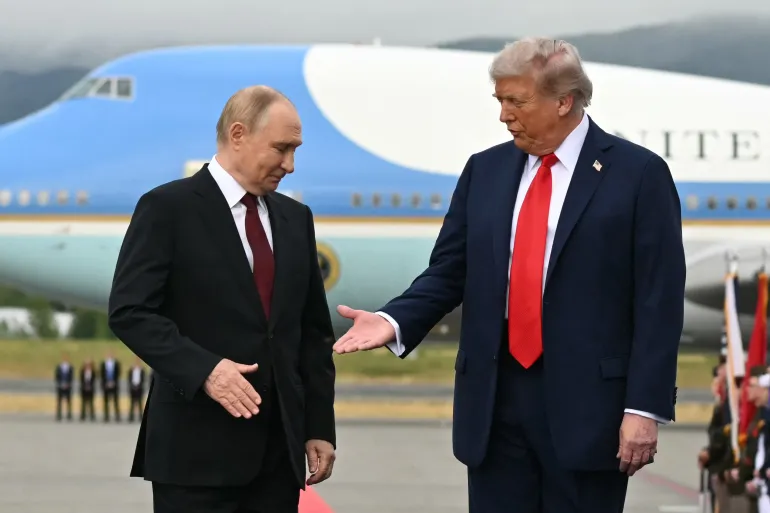
US President Donald Trump’s description of Russian President Vladimir Putin as “my friend” has drawn criticism from Polish leaders, amid growing concerns among European governments over Washington’s approach to negotiations aimed at ending the war in Ukraine.
Polish Prime Minister Donald Tusk appeared to take a swipe at Trump following his remarks, posting on social media: “God, protect us from such friends.”
Tusk’s comment came hours before he attended a meeting of the Coalition of the Willing in Berlin, a group of countries supporting Ukraine. The meeting was attended by the leaders of Germany, France, Britain and Italy, alongside Ukrainian President Volodymyr Zelensky and NATO Secretary-General Mark Rutte.
US representatives Steve Witkoff and Jared Kushner also participated and were expected to brief European leaders on Trump’s discussions with Putin in China.
Polish Foreign Minister Radosław Sikorski also questioned Trump’s public display of warmth towards the Russian leader, expressing concern over the implications of describing Putin as a friend.
“The optics of this cosying up to Putin—calling him a ‘friend’—cause us some concern, because it raises the question: with whom is he truly friends?” he reportedly told journalists.
Before holding a trilateral meeting with Putin and Chinese President Xi Jinping, Trump had praised his “great relationship” with the Russian president and expressed optimism about ending the war in Ukraine.
“I think things are happening. I think that he and—I hope—the other side would like to see an end to that war,” Trump said.
However, a China-US-Russia peace declaration released by Chinese state media after the meeting made no mention of Ukraine.
The summit came amid renewed attacks by Russian and Ukrainian forces on strategic bridges. Ukrainian forces struck the Kerch Bridge, which links Russia to occupied Crimea, and reportedly targeted it again early on Thursday, November 19.
Meanwhile, European governments have continued to tighten sanctions against Moscow, while Trump’s approach to the conflict has raised concerns among Washington’s allies.
Last month, Trump waived sanctions on Russia to facilitate a diesel agreement with Putin aimed at reducing fuel prices, which had risen amid the war with Iran.
On October 11, Trump also announced an “energy ceasefire” between Russia and Ukraine, urging both countries to stop attacking each other’s energy infrastructure.
Zelensky subsequently accused Russia of violating the arrangement and resumed attacks on Russian oil facilities despite pressure from Washington.
Trump criticised Ukraine’s renewed strikes, describing them as a “disgrace” and saying Zelensky was “more difficult to deal with than Putin”.
The Ukrainian president has repeatedly insisted that Ukraine and European countries must be involved in any negotiations to end the conflict.
Speaking at the Berlin meeting, Zelensky thanked “everyone who strengthens our defence and works to bring Russia’s war to an end”.
Following talks with Putin in Moscow last week, Witkoff disclosed that a European representative would participate in the next phase of negotiations, which are expected to cover broader European security arrangements.
“They’re our partners, and it’s important for them to be involved,” he said.
His visit to Moscow followed two days of US-mediated discussions between Russian and Ukrainian delegations in Abu Dhabi, which ended without any major breakthrough.
However, Russia’s chief negotiator at the talks, Kremlin aide Vladimir Medinsky, has expressed reservations about European involvement, potentially complicating efforts to expand the negotiations.
At the European Political Community summit in Dublin last week, French President Emmanuel Macron defended Europe’s right to participate in discussions about the continent’s security when asked whether its exclusion undermined its credibility.
“We are those who support Ukraine. We are those who help them in this resistance war. There is no more U.S. support,” Macron said.
“We will be the ones to define and decide for our future security as Europeans. I have no doubt about that.”
EU foreign policy chief Kaja Kallas also announced on Monday that member states had approved additional sanctions targeting Russian oil refineries, banks, e-commerce interests and companies suspected of supporting Moscow’s shadow fleet of vessels used to circumvent restrictions on energy exports.
She added that the EU’s 22nd sanctions package against Russia would be presented in full within days.
Disagreements over Ukraine have further strained relations between Europe and Washington, alongside differences over the war with Iran, NATO defence spending and trade tariffs.
European leaders declined to take an active role in the Iran conflict, attracting criticism from Trump, while the resulting energy crisis added to tensions between both sides.
Some European leaders have also interpreted the Democrats’ sweeping victories in the US midterm elections earlier this month as a rejection of the Trump administration’s policies.
Spanish Prime Minister Pedro Sánchez, who has previously clashed with Trump, said: “American society voted against policies that only make people poorer. Against hate. Against sexism. Against climate denial and against elite privilege.”