
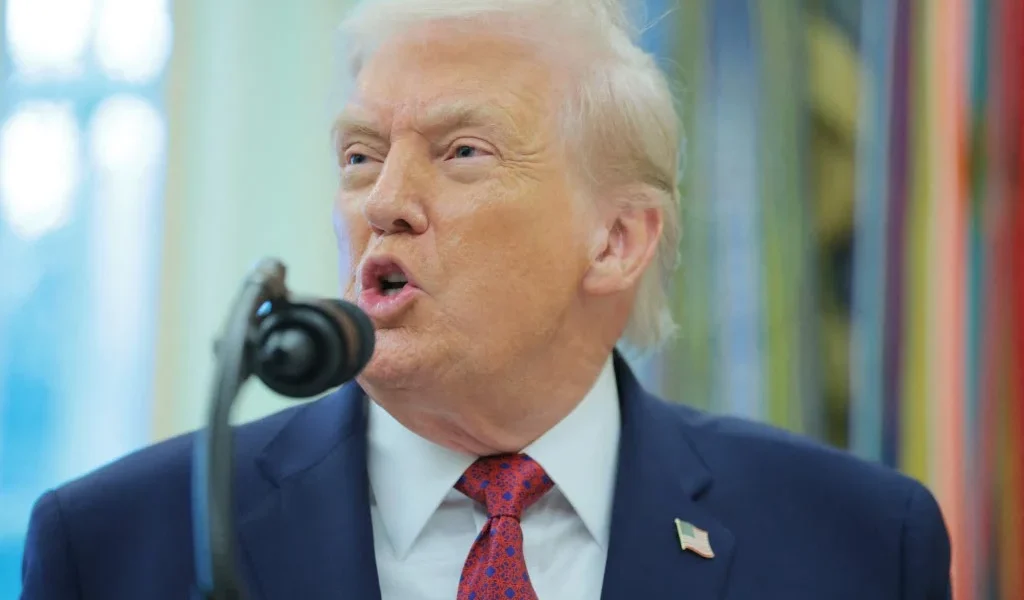
President Donald Trump said on Saturday that the United States would take control of Venezuela and exploit its vast oil reserves following a dramatic military operation that removed leftist leader Nicolás Maduro from power.
Trump’s remarks came just hours after a rapid overnight assault on Caracas, during which US special forces detained Maduro and his wife as airstrikes hit multiple strategic targets across the capital, shocking residents.
Speaking at a press conference in Florida, Trump offered few specifics about how the US would govern Venezuela, saying only that Washington would be “running it with a group” and that senior cabinet officials would oversee the process.
In another striking statement, Trump suggested that American troops could be deployed on the ground in Venezuela, saying the United States was “not afraid of boots on the ground.”
Although the operation has been described as a law-enforcement action, Trump made clear that regime change and access to Venezuela’s oil wealth were central objectives. He said major US oil companies would invest billions of dollars to repair damaged infrastructure and restart large-scale production.
“We’ll be selling large amounts of oil,” he said.
Trump later posted an image showing Maduro in custody aboard a US naval vessel, blindfolded and handcuffed. Maduro and his wife were reportedly being transferred to New York to face narcotics and terrorism charges.
Opposition sidelined
US-backed opposition leader María Corina Machado, who won the Nobel Peace Prize last year, hailed the operation on social media, declaring, “The hour of freedom has arrived.” She called for opposition candidate Edmundo González Urrutia to immediately assume the presidency.
Trump, however, dismissed the idea that Machado would lead the country, saying she lacked sufficient support inside Venezuela. Instead, he suggested he could work with Maduro’s deputy, Delcy Rodríguez, describing her as “willing to do what’s necessary.”
He also indicated that the US presence would not be temporary, saying American forces would remain until a “proper transition” was achieved.
International reaction was swift. The United Nations secretary-general expressed deep concern that international law had not been respected. China strongly condemned the operation, while France warned that Venezuela’s crisis could not be resolved through external force.
Overnight assault
US military assets, including the aircraft carrier USS Gerald R. Ford, had been positioned off Venezuela’s coast for months. Residents of Caracas were awakened around 2:00 a.m. by explosions and helicopter activity as airstrikes hit a major military base, an airfield, and other sites for nearly an hour.
Trump said the operation began with a partial blackout caused by US cyber capabilities. The top US military officer, General Dan Caine, said about 150 aircraft supported the mission, which relied on months of intelligence gathering into Maduro’s daily routines.
Maduro and his wife reportedly surrendered without resistance, and US officials said there were no American casualties.
Within hours, Caracas fell largely silent, with police deployed around government buildings and smoke lingering in the air.
Justifications questioned
The United States and several European governments had already rejected Maduro’s legitimacy, accusing him of rigging elections in 2018 and 2024. Maduro, who has ruled since 2013, had long accused Trump of seeking to overthrow him to gain control of Venezuela’s oil reserves.
Trump defended the operation by blaming Venezuela for drug-related deaths in the United States, though he has cited multiple reasons over time, including migration, narcotics trafficking, and energy interests.
Some members of Congress quickly raised concerns about the legality of the action. However, House Speaker Mike Johnson, a key Trump ally, described the operation as “decisive and justified.”
