
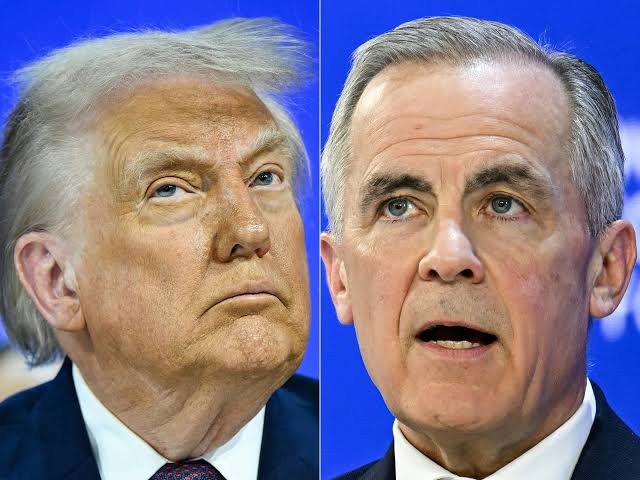
US President Donald Trump has threatened the European Union with “very serious tariffs” and a possible halt to trade if the bloc proceeds with plans to make Canada its first-ever associate member.
Trump dismissed the proposal as “laughable” and warned that Washington could respond with punitive trade measures if the EU moves ahead.
“If it’s a good intention, that’s fine. If it’s a bad intention, we’ll put very heavy tariffs on Europe,” Trump said.
He added that the US could impose “very serious tariffs or stop trading with Europe” if the EU proceeded with the plan.
The threat came as Canadian Prime Minister Mark Carney prepared to address the European Parliament on Thursday, a day after European Commission President Ursula von der Leyen invited Canada to become the EU’s first associate member.
Von der Leyen proposed closer cooperation between the EU and Canada in areas including technology, defence and energy, arguing that democracies needed to strengthen their ties amid what she described as a “fracture in the international rules-based system.”
“This is a partnership not against anyone else, but for our common strength,” she told the European Parliament. “In short, we want to bring the relationship with Canada to the highest level possible.”
Responding to Trump’s comments, France’s Europe Minister Benjamin Haddad said the US had no authority to determine the EU’s political direction.
“It is not up to the United States, or anyone else, to choose the political and geopolitical direction of the Europeans,” Haddad said.
“Once again, we have a relationship with Canada, and we are fully entitled to seek to deepen it.”
A European Commission spokesperson similarly defended the proposal, saying: “As our president made clear yesterday, the proposed strengthening of the relationship with Canada is not against anyone else, but for our common strength.”
Carney has called for a “unique alliance” with the EU as Canada seeks to reduce its dependence on trade with the US.
Following meetings with EU leaders in Strasbourg, Carney described Canada and the EU as “natural partners, united by shared values” and said both sides were working towards “a deeper partnership that reinforces our mutual sovereignty to create more opportunities and prosperity for our peoples.”
Any associate membership agreement would require approval from all 27 EU member states. While EU countries generally support closer relations with Canada, the proposed associate membership concept has taken some officials by surprise.
Canada and the EU already have a trade agreement and several bilateral arrangements, but their relationship has deepened since Trump returned to the White House and imposed tariffs on traditional US allies.
Trump has also repeatedly spoken about Canada becoming the 51st US state and criticised the EU over trade and other issues.
Canada has also taken steps to diversify its defence partnerships. Carney’s office announced that Ottawa had formally applied to join the British-led Joint Expeditionary Force, a rapid-response military partnership involving 10 NATO member states, including Denmark, the Netherlands, Norway and Sweden.
Carney and British Prime Minister Andy Burnham also held a bilateral meeting before attending Everton’s match against Wolves. Their discussions focused on strengthening defence cooperation and addressing the opportunities and challenges posed by artificial intelligence.
Downing Street said both leaders stressed the importance of maintaining close ties with European partners, particularly in trade and defence.
The EU has never previously had an associate membership category, although it maintains close relationships with countries such as Norway, Iceland and Switzerland, which have varying degrees of access to the bloc’s economic structures and follow many EU rules.
It remains unclear what the proposed associate membership would entail, including the extent of Canada’s relationship with the EU single market.
Von der Leyen said the EU wanted to move beyond trade cooperation and build a broader “alliance for the future” with Canada.
“We will work on intelligent manufacturing. We will create a tech alliance. We will integrate defence industrial bases. We will make the Arctic a flagship joint project,” she said.
She also identified energy, critical minerals, batteries, artificial intelligence, cybersecurity and economic security as areas for closer cooperation.
“This is a partnership not against anyone else, but for our common strength,” von der Leyen said.
