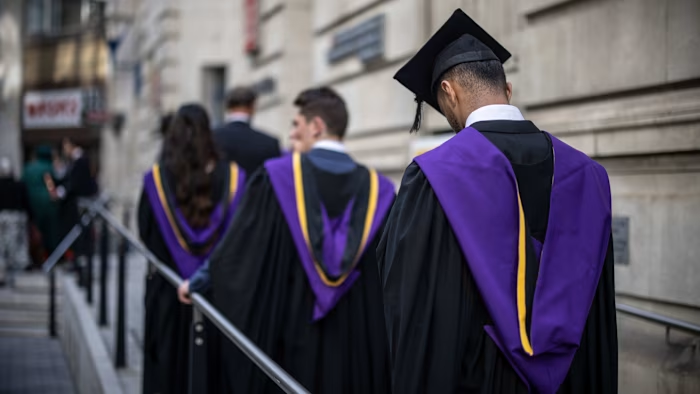
Universities across the United Kingdom are reportedly withdrawing admission offers from some international students, including Nigerians, amid growing concerns that rising visa refusal rates could put their ability to recruit overseas students at risk.
According to an analysis by the Financial Times of UK Home Office data, 22.7 per cent of Nigerian study visa applications were withdrawn during the first half of 2026, a sharp increase from 4.5 per cent during the same period in 2025.
The increase was even greater among Pakistani applicants, rising from three per cent to 40.9 per cent. Bangladesh saw withdrawals increase from 7.1 per cent to 23.5 per cent, while the figure for Indian applicants rose from 1.2 per cent to 5.2 per cent.
Overall, 10.5 per cent of UK study visa applications were withdrawn during the first six months of 2026, compared with 2.3 per cent a year earlier and just 0.4 per cent in 2023.
Why universities are withdrawing offers
International students can generally apply for a UK study visa only after receiving the necessary sponsorship documentation from an educational institution. If a university subsequently withdraws its offer or sponsorship, the associated visa application may also be withdrawn.
Although visa applications can be withdrawn for several reasons, universities reportedly said much of the recent increase was linked to institutions cancelling offers because of concerns over tougher government compliance requirements.
Under revised rules, universities risk losing their ability to sponsor international students if more than five per cent of applicants they sponsor have their visa applications rejected. The previous threshold was 10 per cent.
The tighter requirement has reportedly encouraged some universities to reduce recruitment from countries experiencing higher visa refusal rates.
Around 15 UK universities are believed to have suspended recruitment from Pakistan entirely this year, while visa-processing company Enroly reportedly found that refusal rates at almost half of universities were above the five per cent threshold.
University of Sunderland Vice-Chancellor Sir David Bell said an unexpected increase in visa refusals had forced some universities to take preventive measures, including reducing recruitment in international markets where visa applications were facing tougher scrutiny.
Jamie Arrowsmith, director of Universities UK International, said universities recognised the need to maintain confidence in Britain’s immigration system but argued that visa decision-making had become significantly less predictable.
He claimed some refusals were based on inconsistent or subjective reasoning, leaving universities with little choice but to withdraw offers in order to avoid breaching government compliance thresholds.
Universities warn of job and course cuts
University leaders have also warned that the restrictions could worsen financial pressures across Britain’s higher education sector, where international tuition fees provide an important source of revenue.
Vanessa Wilson, chief executive of University Alliance, warned that falling international enrolments could result in university restructuring, job losses, course closures and even campus closures.
Some universities also raised concerns about the reasons reportedly given for individual visa refusals.
Professor Steven McGuire, deputy vice-chancellor of the University of East Anglia, said his institution began withdrawing offers from applicants in certain countries after experiencing a sharp increase in refusals.
He described some decisions as arbitrary, citing an example in which an applicant was reportedly rejected after an interviewer appeared not to understand that the University of East Anglia was located in Norwich.
Professor James Miller, vice-chancellor of the University of the West of Scotland, also criticised some visa refusals and said universities had begun reducing recruitment from certain regions to keep their rejection rates below the five per cent threshold.
He warned that some institutions could experience falls of more than 20 per cent in international student numbers this year, potentially making job losses unavoidable.
The UK Home Office said international students continue to make a positive contribution to Britain but stressed that universities must recruit responsibly to protect the integrity of the country’s immigration system.
It added that institutions were being offered support to improve their international recruitment practices.
The developments could have significant consequences for Nigerian students hoping to study in Britain, as universities become increasingly cautious about issuing offers to applicants from countries experiencing higher visa refusal rates.