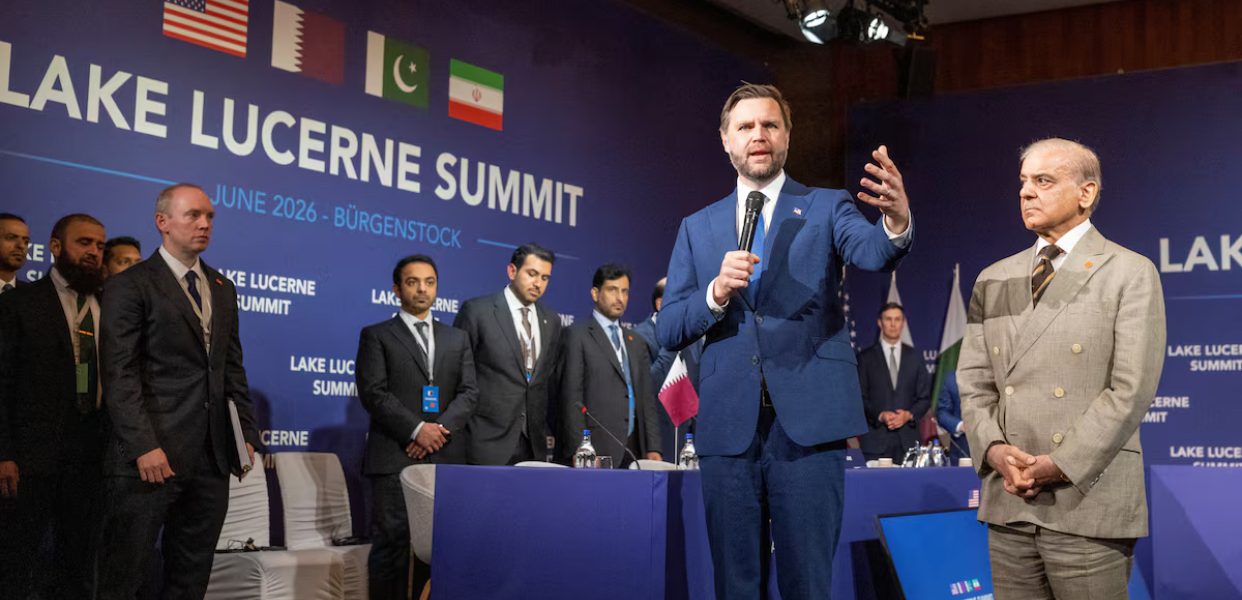
High-level talks between senior U.S. and Iranian officials in Switzerland concluded on Monday, mediators said, after a tense opening marked by renewed friction over the Strait of Hormuz and sharp rhetoric from U.S. President Donald Trump.
A joint statement issued by Qatar and Pakistan, who are mediating the discussions, said both sides had agreed to a roadmap aimed at securing a final agreement within 60 days.
According to the statement, technical-level negotiations will continue throughout the week at the Swiss resort of Bürgenstock. It added that both parties had also agreed on mechanisms to support a ceasefire in Lebanon and to establish communication channels aimed at ensuring safe passage for commercial shipping through the strategic Strait of Hormuz.
The talks, led by U.S. Vice President JD Vance and senior Iranian officials, began under the framework of a memorandum of understanding reached last week to extend a fragile ceasefire linked to the wider regional conflict. Discussions reportedly continued into the early hours of Monday.
Iranian Foreign Minister Abbas Araqchi said on social media that Tehran had secured concessions including waivers for oil and petrochemical exports, the release of some frozen assets, and the launch of a reconstruction and development plan.
The White House did not immediately comment on whether the main phase of the talks had ended.
Tensions escalated ahead of the negotiations after reports that Iran had again restricted maritime traffic through the Strait of Hormuz, a critical global shipping route. Trump also issued stark warnings, saying Iran risked severe consequences if it attempted to close the waterway.
“You won’t have a country” if Iran shut the strait again, Trump reportedly said, also reiterating earlier threats of further military action and suggesting the U.S. could take control of the route and impose transit fees.
Oil prices reacted to the developments, with Brent crude futures falling further to around $79.44 per barrel following the joint statement.
Accounts of the negotiations varied. Iran’s semi-official Tasnim news agency reported that Iranian negotiators briefly refused to re-enter talks after Trump’s remarks, though communication reportedly continued through Qatari and Pakistani mediators. Tehran also insisted that nuclear discussions could not proceed until other elements of the agreement—such as asset releases and export waivers—were implemented.
However, a U.S. diplomat involved in the process said the Iranian delegation remained engaged throughout. “We’ve talked about the Strait, Lebanon, nuclear issues, and details of implementing the MOU, among other topics,” the official said.
The agreement framework reportedly includes reopening the Strait of Hormuz, de-escalating hostilities in Lebanon, and restoring maritime stability in the region. Fighting has continued intermittently in Lebanon, where Israeli strikes and Hezbollah attacks have persisted despite a declared ceasefire.
Iran accused Israel of violating the truce and temporarily halted maritime traffic through the Strait in response, though five vessels reportedly passed through on Sunday, down sharply from 26 the previous day, according to ship-tracking data.
Despite ongoing tensions, Sunday saw a relative lull in major violence in Lebanon after several days of heavy clashes. More than one million people have been displaced since Israel’s ground operations began in March, according to local reports.