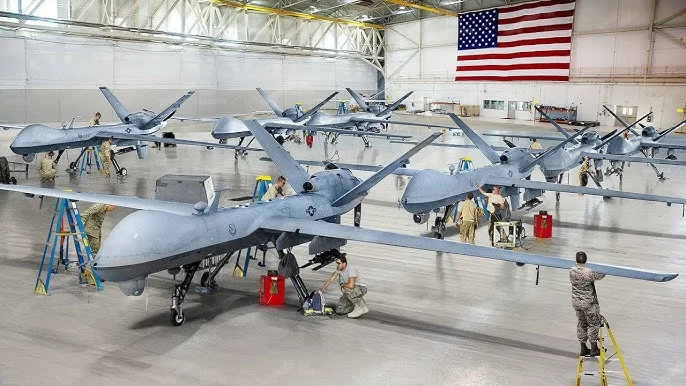
The United States has deployed multiple MQ-9 drones along with about 200 troops to Nigeria to support the country’s military with intelligence and training in its fight against insurgents in the northern region.
According to U.S. and Nigerian officials who spoke to Reuters, the mission is focused strictly on surveillance and advisory roles, with no American personnel embedded in frontline combat units and no drone airstrikes currently being carried out.
“The U.S. military has multiple MQ-9 drones operating in Nigeria alongside 200 troops to provide training and intelligence support to the military,” officials said.
The deployment, requested by Nigerian authorities, is aimed at helping identify, track and respond to terrorist threats across the region. A U.S. defence official described the mission as part of a joint effort to tackle a shared security challenge, noting that American forces are only involved in intelligence gathering and advisory support.
Major General Samaila Uba, Director of Defence Information at Nigeria’s Defence Headquarters, confirmed that the U.S. personnel are operating from an airfield in Bauchi State in the northeast.
“This support builds on the newly established U.S.–Nigeria intelligence fusion cell, which continues to deliver actionable intelligence to our field commanders. Our U.S. partners remain in a strictly non-combat role, enabling operations led by Nigerian authorities,” he said.
The MQ-9 drones, commonly known as Reaper drones, are capable of flying at high altitudes for more than 27 hours and can carry out both surveillance and strike missions. However, officials stressed that the aircraft currently deployed in Nigeria are being used solely for intelligence and monitoring operations.
“Our U.S. forces are helping Nigeria identify, track and respond to terrorist threats,” Uba added.
The deployment comes as violence continues in parts of northern Nigeria. On March 16, suicide bombers attacked a garrison town in the northeast, highlighting the ongoing threat posed by extremist groups such as Boko Haram and the Islamic State West Africa Province (ISWAP).
“We continue to assess that these organisations will seek opportunistic targets and may attempt to demonstrate relevance through high-visibility attacks,” Uba said.
Nigeria’s military said the length of the current U.S. deployment will be determined through ongoing discussions between both countries, describing the mission as part of intensified cooperation on intelligence-sharing and capacity-building.
The latest move follows earlier counter terrorism cooperation between the two nations. On Christmas Day, U.S. airstrikes ordered under President Donald Trump targeted ISIS-linked elements in northwest Nigeria as part of a coordinated security partnership with international allies.
In February, reports indicated that the United States had already deployed around 200 troops to assist Nigeria through training programmes and operational support aimed at strengthening the country’s counterterrorism capabilities.