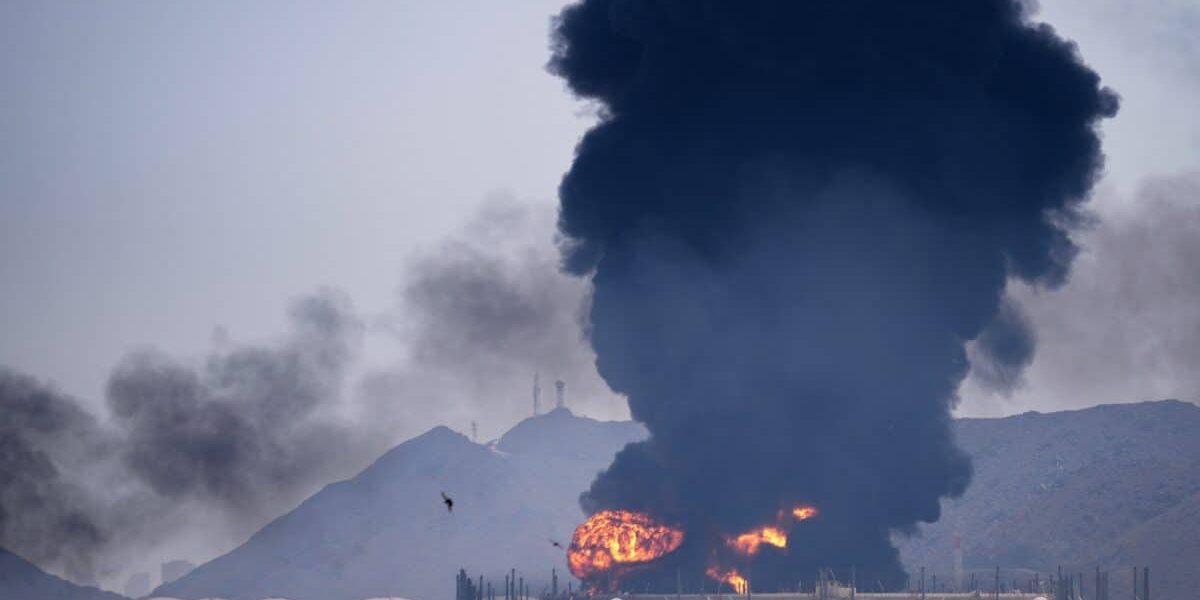
The United States has carried out a military strike on Larak Island, located in the Strait of Hormuz, further escalating hostilities between Washington and Tehran as the conflict enters a new phase.
The strike follows recent comments by US President Donald Trump, who said the United States was “not finished” with its military operations against Iran.
The latest attack comes after renewed fighting disrupted a preliminary agreement that had sought to reduce tensions between the two countries. Despite the ongoing conflict, US Secretary of State Marco Rubio said Washington remains open to a diplomatic resolution.
“We remain open to working it out in a negotiated way. But right now, they don’t seem to be serious about that,” Rubio said.
Rubio defended the military operation, accusing Iran of targeting commercial shipping in the Strait of Hormuz and attempting to rebuild its missile and drone capabilities.
Iranian Foreign Ministry spokesperson Esmaeil Baqaei disputed those claims, insisting that diplomatic contacts between the two countries were continuing through international mediators.
According to Iran’s Tasnim News Agency, a US missile struck Larak Island on Wednesday, with Iranian authorities assessing the extent of the damage. The report said the attack was part of a series of strikes targeting Iranian positions in the Gulf and Strait of Hormuz since hostilities resumed.
The Pentagon estimates that the conflict has already cost the United States approximately $37.5 billion. Despite growing domestic calls for de-escalation ahead of November’s legislative elections, President Trump signalled that military operations would continue.
“We’re not finished at all… we’re not leaving right now,” Trump said.
The US military also confirmed it had carried out an 11th consecutive night of airstrikes, saying the operations were intended to reduce Iran’s ability to threaten commercial shipping through the strategically important Strait of Hormuz.
President Trump also warned that a future target could be the Pickaxe Mountain (Kolang Mountain) underground complex near Natanz, where Western intelligence agencies suspect Iran may be developing an undeclared uranium enrichment facility.
Iran strongly rejected the allegations, warning that any strike on the site would represent a major escalation of the conflict.
The Khatam al-Anbiya Central Headquarters said it would view such an attack as an expansion of the war and threatened to target American interests, as well as those of US allies and supporters across the region.
Baqaei also dismissed claims of nuclear activity at the site and accused Washington of using the allegations to justify further military action. He criticised the International Atomic Energy Agency (IAEA) and questioned why its Director General, Rafael Grossi, had not visited the country amid the crisis.
Earlier, Grossi told the BBC that IAEA inspectors should return to Iran to verify the country’s stockpile of highly enriched uranium.
The conflict has also spread across the wider Gulf region.
Kuwait reported intercepting Iranian drones, while Jordan said its air defence systems shot down four missiles and four drones. Air raid sirens were activated in Bahrain after explosions were heard in the capital, Manama.
Iran’s military claimed responsibility for attacks targeting US military assets in Kuwait, Bahrain and Jordan, including radar systems, air defence installations and military facilities.
Meanwhile, Yemen’s Houthi movement threatened to blockade Saudi Arabian ports, prompting President Trump to warn that the United States would respond if such actions were carried out.
Although no new attacks on commercial shipping have been confirmed, maritime intelligence firm Vanguard Tech reported that two oil tankers reversed course in the Red Sea after loading crude oil from Saudi Arabia’s Yanbu port.
The renewed tensions pushed global energy prices higher, with Brent crude oil rising 4.4 per cent to more than US$95 per barrel, its highest level in six weeks. Analysts warned that any disruption to Saudi Arabia’s export routes could have significant consequences for global oil markets and the wider economy.