
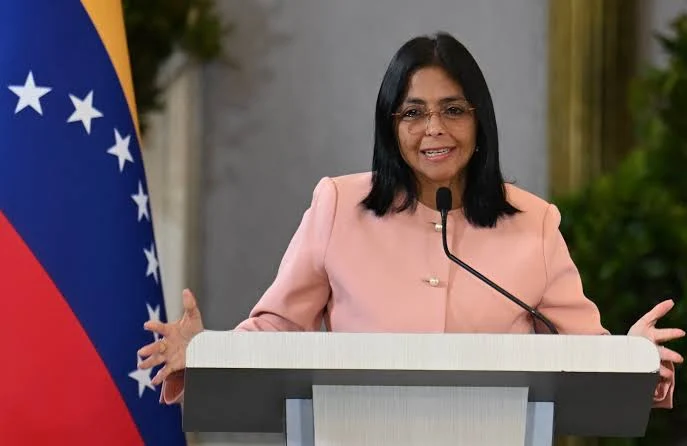
Venezuela’s acting president on Friday announced plans for a sweeping amnesty, marking her latest major reform just weeks after the United States ousted Nicolas Maduro.
Delcy Rodríguez said she would propose a broad amnesty law covering “the entire period of political violence from 1999 to the present,” during a speech at the Venezuelan Supreme Court attended by senior government officials.
Former leftist leader Hugo Chávez came to power in 1999 and was succeeded after his death in 2013 by Maduro, whose increasingly authoritarian rule and two re-elections were widely dismissed as fraudulent.
“This law aims to heal the wounds caused by political confrontation driven by violence and extremism,” Rodríguez said. “It will help restore justice in our country.” She also announced plans for a nationwide consultation to overhaul Venezuela’s judicial system.
Rodríguez further revealed intentions to shut down the infamous El Helicoide prison in Caracas, where human rights groups say political detainees were tortured by Maduro’s intelligence services. The vast complex—originally designed as a shopping mall—will be converted into a sports, cultural, and commercial center for police families and surrounding communities.
Outside the prison, relatives of inmates reacted with hope. Betsy Orellana, 63, whose son is imprisoned inside El Helicoide, said the announcement brought overwhelming relief. “It’s wonderful. I haven’t heard from my son in six months. This is an amnesty—total freedom,” she said.
Cautious optimism from the opposition
Rodríguez, 56, who previously served as Maduro’s vice president, has moved swiftly in her first month in power to enact reforms long demanded by Washington, drawing praise from US President Donald Trump.
Alongside her brother, National Assembly President Jorge Rodríguez, she pushed through legislation opening Venezuela’s oil sector to private investment—one of Trump’s key demands. The move was quickly followed by the rollback of US sanctions on Venezuela’s oil industry.
The government had already agreed on January 8—five days after Maduro was captured in a deadly US military operation—to release detainees considered political prisoners by rights groups. However, families and advocacy organizations have criticized the slow pace of releases. The Foro Penal NGO reports fewer than 300 prisoners freed so far.
Opposition leaders have expressed guarded optimism, while warning that many of Maduro’s closest allies remain in power. Nobel Peace Prize laureate María Corina Machado said Rodríguez’s amnesty plan was the result of US pressure rather than goodwill.
“This is not a voluntary act by the regime, but a response to pressure from Washington,” Machado wrote on social media. “I hope the prisoners will soon be reunited with their families.”
Opposition lawmaker Tomás Guanipa, whose two brothers remain imprisoned, said he hoped the amnesty would mark the end of repression. “May this be the beginning of a path toward freedom and democracy, once and for all,” he told AFP.
Americans released
US authorities also announced Friday that all Americans known to have been detained in Venezuela had been released. The announcement followed the freeing of Peruvian-American political prisoner Arturo Gallino Rullier, who was reported to be en route to the United States.
For years, Venezuela routinely detained foreigners and opposition figures on charges ranging from espionage to plotting attacks—accusations critics say were fabricated.
In another sign of warming relations, the Trump administration lifted its ban on US flights to Venezuela and began preparations to reopen its embassy in Caracas after years of closure.
Veteran diplomat Laura Dogu has been appointed US chargé d’affaires for Venezuela and is expected to arrive in Caracas on Saturday, according to diplomatic sources.
