
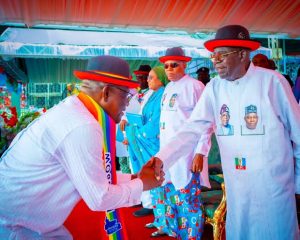
Minister of the Federal Capital Territory (FCT), Nyesom Wike, has appealed to President Bola Ahmed Tinubu and the leadership of the All Progressives Congress (APC) to assign him responsibility for mobilising political support for the President’s re-election in Imo and Kwara states ahead of the 2027 general elections.
Wike, who declared that he was done with Rivers State and the FCT, said he was ready to take on additional political responsibilities in the two states and deliver them for the President.
The minister made the appeal on Wednesday during a Rainbow Coalition Town Hall meeting in Gokana Local Government Area of Rivers State, where he expressed confidence in his ability to expand the ruling party’s political support base beyond his immediate political environment.
He said he had already been assigned to coordinate political activities in Rivers State and the FCT but was now seeking additional states to demonstrate his mobilisation capacity.
“I was assigned to coordinate Rivers and the FCT. Frankly speaking, I am done with these states. All adequate political machineries have been set in motion to deliver Rivers State and the FCT for the President. So, I have no much work to do again,” he declared.
Wike appealed to the Director-General of the APC Presidential Campaign Council, Senator Abdul’aziz Abubakar Yari, and President Tinubu to give him responsibility for two additional states, specifically naming Imo and Kwara.
“As I am going now, I will plead with the DG and Mr President to have two more states for me to deliver,” he said.
Explaining his interest in Imo State, the former Rivers governor said he had received reports of political challenges in the state and was willing to intervene to strengthen Tinubu’s support ahead of the next general election.
“From what I am told, they are having some problems in Imo State. So, I will love to go there and deliver the State for Mr President,” he stated.
On Kwara State, Wike said he had also read reports of divisions within the state’s political structure, although he admitted that he had yet to independently verify the situation.
“Secondly, I have not confirmed, but what I read on social media is that there are some divisions in Kwara. So I plead with the DG of the APC Presidential Council, Senator Yari, and Mr President to allow me take over Imo and Kwara States, because I am done with Rivers and FCT,” he added.
The appeal came as Wike used the Gokana meeting to canvass continued support for Tinubu’s second-term ambition, describing the President as a courageous leader willing to take difficult decisions in the interest of the country.
He cited the removal of fuel subsidy, increased financial allocations to state and local governments, and the establishment of the Federal University of Environment in Ogoniland as some of the interventions that, in his view, justified continued support for the administration.
The minister also commended political stakeholders in Gokana for setting aside their differences and working together under the Rainbow Coalition, stressing that political unity was necessary to achieve common objectives.
He urged residents to sustain their political relationship with Tinubu, arguing that abandoning an existing relationship for an uncertain alternative would be unwise.
Earlier, the former Secretary to the Rivers State Government and Coordinator of the Rainbow Coalition in Gokana, Chief Kenneth Kobani, described the gathering as unprecedented, noting that it brought together different segments of the community.
Similarly, the APC South-South National Vice Chairman, Chief Victor Tombari Giadom, expressed confidence that the coalition would mobilise up to 90 per cent of the votes in Gokana during the 2027 elections.
Senator Magnus Abe also commended Wike for bringing previously divided political leaders together, saying the people of Gokana were united in their expectations from the coalition.
The meeting was attended by political leaders, traditional rulers, religious leaders, women, youths and other stakeholders from Gokana and neighbouring communities.