
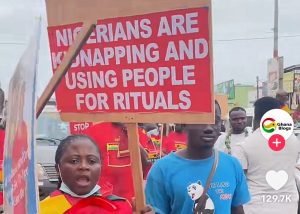
Nigerians residing in Ghana have strongly condemned the “Nigerians Must Go” protest that erupted across parts of the country on Tuesday, July 29, describing it as a deliberate attempt to ignite a diplomatic crisis between the two West African nations.
The protesters, mostly Ghanaians, accused Nigerians of being responsible for rising crime rates, including ritual killings and prostitution. Marching in red T-shirts and waving placards, they chanted slogans and carried inflammatory messages such as: “Our kids are going missing because of Igbos,” “Nigerians must go,” and “Our health is at stake due to mass prostitution.”
Videos circulating online show protesters openly expressing deep-seated resentment. One woman yelled, “You can’t be in someone’s country and behave anyhow,” while another protester claimed Nigerians had “hijacked” their land and warned of an eventual takeover.
Reacting to the development, members of the Nigerian community in Ghana described the protest as the culmination of long-standing discrimination, economic hostility, and social bias. Businessman Patrick Isaac told Saturday PUNCH that the protest was a calculated provocation aimed at forcing a reaction from Nigerians.
“We were warned not to retaliate. Their plan was to spark violence that could spiral into a diplomatic standoff between our countries,” he said.
Isaac cited cases of extortionate rents imposed on Nigerians and selective business regulations designed to force them out of Ghana’s retail sector. He stressed that the protest had little to do with recent comments made by Igbo community leader, Chukwudi Ihenetu, and everything to do with resentment over the economic success of Nigerian traders.
“Some Ghanaians can’t stomach the fact that many Nigerians live better lives. It’s envy disguised as nationalism,” he added.
Another Nigerian trader, who requested anonymity, said the protest was an extension of earlier attempts to marginalise Nigerian businesses, including the controversial $1 million Ghana Investment Promotion Centre (GIPC) levy. The law mandates that all foreign traders—including Nigerians—invest a minimum of $1 million to operate legally.
“This isn’t new. In 2017 and again in 2019, they shut our shops and tried to ban foreigners from retail business. Now it’s protests. It’s harassment in another form,” he said.
Fashion designer Emmanuel Chubike also expressed concern, citing a spike in housing discrimination. “Many landlords have issued quit notices to Nigerian tenants. My own rent was increased by 50% for no reason,” he lamented.
Calls have intensified for both the Ghanaian and Nigerian governments to de-escalate tensions. Chubike urged leaders on both sides to promote mutual respect and peaceful coexistence.
Meanwhile, investigations suggest that the protests may have been triggered by a resurfaced 2013 video of Chukwudi Ihenetu, a prominent Nigerian community leader in Ghana, where he announced plans to build an “Igbo Village” in the country. In the video, Ihenetu revealed he had acquired 50 acres of land in Old Ningo to build a market, palace, town hall, and streets named after iconic Igbo figures like Nnamdi Azikiwe and Sam Mbakwe.
While some Ghanaians viewed the move as a cultural celebration, others saw it as a challenge to national sovereignty—further inflaming tensions.
Nigerians in Ghana now fear increased hostility and urge their High Commission to act more decisively in protecting their interests. As tensions grow, the future of Nigerian-Ghanaian relations hangs in the balance.