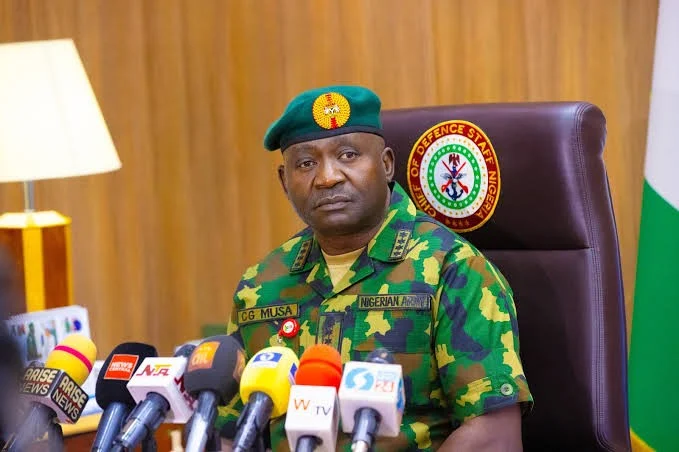
The Minister of Defence, Christopher Musa, has said ongoing conflicts involving Israel, Iran, the United States, Russia and Ukraine are complicating efforts by Nigeria and other nations to acquire military equipment needed to combat insecurity.
Speaking on Saturday at the Nigerian People’s Strategic Conference and Defence Exhibition 2026 in Abuja, Musa said the growing global demand for military hardware had made procurement increasingly difficult, underscoring the need for Nigeria to expand its domestic defence production capacity.
According to him, countries involved in the conflicts often secure equipment in advance because they have the financial resources to place large orders.
“With the wars involving Ukraine, Russia, Iran, the United States and Israel, obtaining military equipment has become extremely challenging. In many cases, these countries make advance payments and reserve production capacity, making it difficult for others to access the same equipment,” he said.
“The only sustainable solution is for Nigeria to produce more of what it needs.”
The minister praised local defence manufacturers and innovators, urging the government to provide greater support and patronage for indigenous military technologies and equipment.
Calls for National Database
Musa also highlighted the absence of a comprehensive national database as a major obstacle to effective policing and crime prevention.
He appealed to the National Assembly to support the development of a reliable database covering all Nigerians, describing it as a critical tool for security agencies.
“We need a database for every Nigerian, wherever they may be. The technology exists to achieve this, and it would significantly improve the work of our security agencies,” he said.
“The Nigerian Police Force is facing serious challenges because it lacks a comprehensive system for tracking and identifying individuals.”
Despite these limitations, the minister commended the police for their efforts in tackling crime.
“I must commend the police because they are achieving remarkable results under very difficult circumstances. Solving many of these crimes without a functional database is extremely challenging,” he added.
Public Support Essential
Musa stressed that security agencies depend heavily on timely intelligence from citizens and cannot effectively combat crime without public cooperation.
“Security agencies are not magicians. Without the right information at the right time, it becomes extremely difficult to prevent or respond to criminal activities,” he said.
He pointed to recurring cases of vandalism targeting roads, railway infrastructure and solar-powered streetlights, noting that many such crimes could be prevented if residents reported suspicious activities promptly.
Addressing Root Causes of Insecurity
The defence minister also urged state governors to ensure that increased federal allocations translate into meaningful development at the grassroots level.
According to him, poverty, unemployment and illiteracy remain major drivers of insecurity across the country.
“Too much responsibility is often placed on the Federal Government alone. President Bola Tinubu has ensured that states receive significantly more resources, and it is important that these funds are used to improve the lives of citizens and address poverty and illiteracy,” he said.
Musa further advocated proper regulation of the Civilian Joint Task Force and other community-based security groups, warning that arming unregulated outfits could create additional security risks.
National Assembly Backs Security Reforms
Also speaking at the conference, Deputy Speaker of the House of Representatives Benjamin Kalu reaffirmed the National Assembly’s commitment to supporting security agencies through legislation, oversight and funding.
However, he noted that military action alone cannot resolve Nigeria’s security challenges.
Kalu said local government reforms remain a key focus of the ongoing constitutional review process and called for support for the State Police Bill, which recently passed the House of Representatives.
“On June 11, 2026, the House of Representatives achieved a major milestone with the passage of the State Police Bill, which I sponsored after years of debate and unsuccessful attempts by previous assemblies,” he said.
He argued that Nigeria’s highly centralised policing system is no longer adequate for a population exceeding 220 million people.
The deputy speaker also urged stronger collaboration with the private sector, saying businesses, technology companies and financial institutions have important roles to play in addressing evolving security threats.