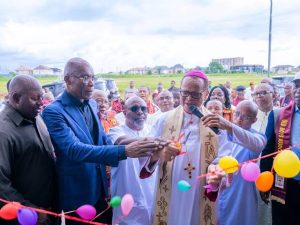
The Leo Stan Ekeh Foundation (LSEF) has donated a state-of-the-art Artificial Intelligence and Technology Centre to Holy Ghost College, Owerri, as part of activities marking the institution’s 77th anniversary celebration.
The multi-million-naira facility, established by renowned Nigerian technology entrepreneur and founder of the Zinox Group, Leo Stan Ekeh, is designed to provide students with access to modern digital learning tools and advanced technology education.
The centre is equipped with integrated all-in-one Zinox computers, a 24-hour solar-powered electricity system, and high-speed Starlink internet connectivity, fully subscribed to for the next five years.
It also features eco-friendly workstations, modern furniture, and large AI-enabled interactive screens to support real-time online tutorials and digital learning activities.
The facility is expected to position Holy Ghost College among Nigeria’s emerging technology-driven secondary schools, providing students with greater access to global learning opportunities and digital skills development.
Speaking at the inauguration, Ekeh, an alumnus of the institution, said the project was inspired by his desire to prepare young Nigerians for success in the global knowledge economy.
According to him, the centre is intended to nurture future innovators, entrepreneurs, and technology leaders capable of creating wealth, driving innovation, and contributing to national development.
He noted that plans are already underway to transform the facility into a certified training hub for leading global technology companies, including Microsoft, Cisco, Oracle, and Starlink.
Ekeh also disclosed that a management team, including a director and support staff, would be recruited to ensure the effective operation and sustainability of the centre.
Beyond technology education, he said the initiative would incorporate mentorship programmes focused on leadership, ethics, communication skills, and personal development.
The philanthropist revealed that through the Leo Stan Ekeh Foundation and companies within the Zinox Group, similar educational interventions have been implemented in more than 123 educational institutions across Nigeria since 1996.
He further announced that after completing ongoing projects, the Foundation would intensify efforts on its recently launched 1,000 Tech University Scholarships programme aimed at supporting indigent Nigerian students.
According to him, the initiative is part of efforts to give back to society and contribute to the development of world-class human capital capable of driving Nigeria’s future growth.
Ekeh also unveiled plans to renovate one of the school’s hostels into a smart facility equipped with AI-powered amenities to encourage academic excellence and healthy competition among students.
He described the AI-Tech Centre as one of the first of its kind in South-East Nigeria and urged students to maximise the opportunities it provides.
“In the 21st century, technology remains one of the greatest equalisers, offering young people from all backgrounds the opportunity to compete globally and transform their futures,” he said.
As a show of support for the initiative, Jerry Chukwueke, Chairman of Germaine Group, donated N10 million to the school.
The facility was officially inaugurated by Lucius Ugorji, who commended Ekeh for what he described as a selfless contribution to education and youth development.
The Archbishop encouraged students to take ownership of the centre, use it responsibly, and leverage it to acquire valuable digital skills for the future.
Principal of the college, Samuel Agu, expressed gratitude to the Ekeh family, describing the intervention as a transformative investment that would shape future leaders across multiple sectors.
Also speaking, Bernard-Thompson Ikegwuoha praised Ekeh for his contribution to educational development in the state, describing him as a worthy ambassador of Imo State whose philanthropy continues to impact lives and communities positively.
The Foundation also announced plans to extend similar projects to at least seven additional secondary schools across Nigeria within the next year, including the establishment of mini-ICT centres and residential facilities for teachers and knowledge workers.